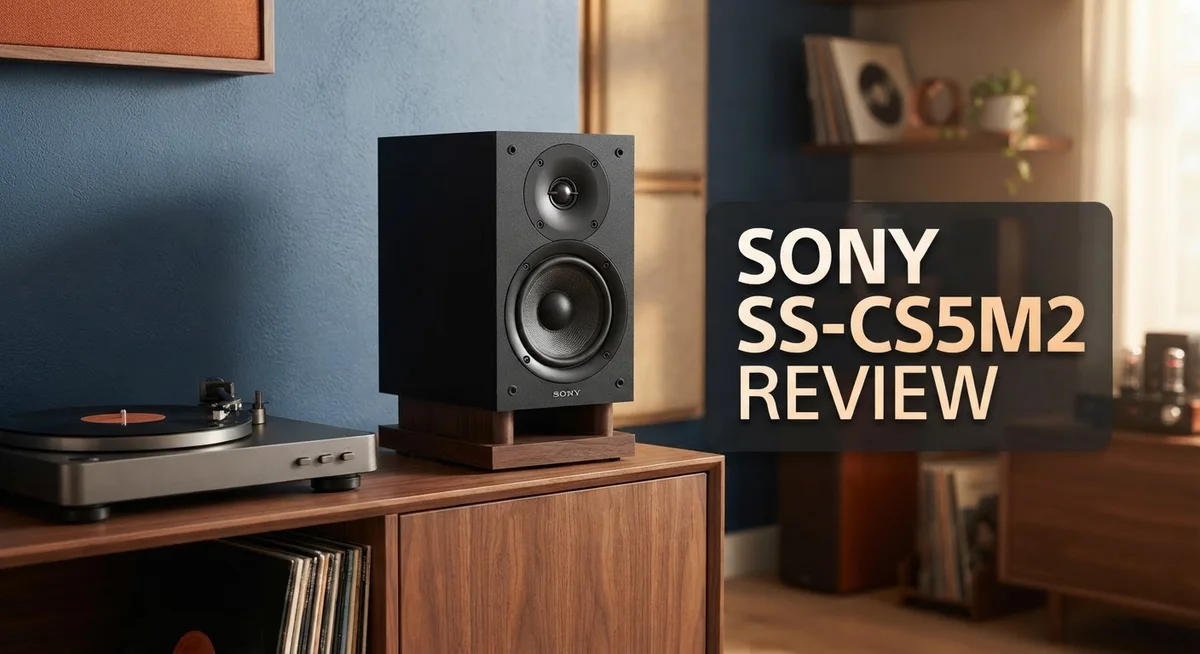
Sony SS-CS5M2 Bookshelf Speaker Review: Sound Quality, Performance & Specs
Looking for a bookshelf speaker that sounds bigger than its size? The Sony SS-CS5M2 might be your answer.
This is a 3 way, 3 driver speaker system. It comes as a pair, with separate drivers for low, mid, and high frequencies. That design helps each sound range shine on its own.
Many listeners praise its clean and accurate sound. The soundstage feels wide and deep. You can hear each instrument in its own space, especially with classical or jazz tracks.
It does have some quirks. You will need a subwoofer for deep bass. There is also a small dip in the midrange that affects certain frequencies.
Still, this speaker holds its own against bigger names like Elac and Paradigm. Let’s dive into what makes the SS-CS5M2 worth your attention.
In a Nutshell
Here’s a quick rundown of what makes the Sony SS-CS5M2 stand out and where it falls short.
-
Wide soundstage: These speakers create a spacious listening feel. Sound seems to stretch beyond the cabinet size.
-
Sharp instrument separation: Classical and jazz tracks shine here. You can pinpoint each instrument with ease.
-
Near field friendly: Sitting close to these speakers works well. They perform nicely on a desk or small room setup.
-
Subwoofer recommended: Bass response has limits on its own. Pairing with a sub gives you fuller low end.
-
A minor dip at 2kHz: Some midrange frequencies dip slightly. This can affect vocal clarity in certain tracks.
-
Strong rival to costlier brands: Compared to Wharfedale Diamond 225 and Pioneer Andrew Jones models, the Sony holds its ground. It competes well on sound quality alone.
These speakers suit listeners who want detailed and balanced audio. They work great for smaller spaces or nearfield setups. Add a subwoofer for a more complete sound experience.
Driver Configuration and Acoustic Design
The Sony SS-CS5M2 uses a three way driver setup that separates sound into distinct frequency ranges. Each driver handles a specific job. The tweeter manages high frequencies. The midrange driver covers the middle tones. The woofer pushes the bass frequencies. This separation allows each driver to perform without interference from the others.
The acoustic design reflects Sony’s focus on clarity. The speaker cabinet is tuned to reduce standing waves inside the enclosure. This means sound bounces less chaotically inside the box. You get cleaner output as a result. The front facing drivers point slightly upward. This helps sound reach ear level when speakers sit on shelves or stands.
One acoustic characteristic you should know about involves the midrange. A 2kHz dip creates a subtle scooped effect in the middle frequencies. This happens because of how the drivers interact directionally. The dip is modest, not dramatic. Some listeners barely notice it. Others find it adds a slightly recessed quality to vocals and instruments in that range.
The driver configuration excels at instrument placement. Each sound source appears in a specific location across the soundstage. Classical music reveals this strength clearly. A violin sits left. A cello anchors the center. A flute floats right. Jazz ensembles maintain similar precision. This happens because the drivers blend smoothly without cancellation issues.
Near field listening benefits from the acoustic design too. Sit close to these speakers and they still sound coherent. The drivers maintain good integration even at short distances. Many bookshelf speakers lose focus up close. The Sony SS-CS5M2 stays tight and controlled.
The cabinet itself plays a role in the overall sound. Rigid construction prevents panel vibrations that would muddy the output. The enclosure is ported, meaning it has a tuned opening on the back. This port reinforces bass output without requiring a subwoofer. However, the port’s tuning means deep bass still needs external support for full impact. The overall acoustic package prioritizes midrange accuracy and soundstage width over bottom end extension.

- Bookshelf speakers (pair), compact bookshelf design for small spaces
- 3-way, 3 driver bookshelf speaker system
- 5.12 in. woofer boosts low-end frequencies

Last update on 2026-11-08 / Affiliate links / Images from Amazon Product Advertising API
Sound Quality and Frequency Response
The Sony SS-CS5M2 delivers transparent and clean sound across most of the audio spectrum. You hear vocals and instruments with minimal coloration, which means the speaker stays true to your original recording.
The frequency response shows strength in the highs and lows. Treble frequencies come through crisp and detailed. Bass extends reasonably well for a compact bookshelf speaker, though you’ll notice limits below 50Hz.
Here’s where things get interesting. The midrange sits slightly recessed due to a dip around 2kHz. This dip occurs because of how the drivers interact directionally. You might notice vocals sound a touch pulled back compared to the highs and lows.
This characteristic affects different music genres differently. Pop and rock recordings may feel less forward. Classical music and jazz shine because instrument separation matters more than vocal presence in these genres.
The three driver setup handles each frequency band separately. The tweeter handles treble with smooth extension. The midrange driver manages vocals and instruments. The woofer pushes bass without strain.
Near field listening works exceptionally well with these speakers. Sit close to them, and the midrange dip becomes less noticeable. The soundstage expands nicely even in smaller rooms.
The acoustic design prioritizes clarity over bass punch. This philosophy suits desktop setups and apartment living perfectly. You get accurate sound without overwhelming your space.
One important note: these speakers reveal what your source material contains. Poor quality recordings sound poor. High quality files sound noticeably better. This honesty is a strength if you feed them good audio.
For classical music, jazz, and acoustic recordings, the Sony SS-CS5M2 shines brightest. The instrument localization becomes almost three dimensional. You can pinpoint where each instrument sits in the soundstage.
If you plan to play mostly bass heavy music like hip hop or electronic, pair these speakers with a subwoofer. The subwoofer fills in what the bookshelf speakers cannot reach. Together, they create a fuller, more complete sound experience that satisfies demanding listeners.
Soundstage and Instrument Localization
The Sony SS-CS5M2 creates a broad, open soundstage that extends well beyond the physical speaker boundaries. You hear instruments positioned across a wide front stage with noticeable depth behind the speakers.
Instrument localization stands out as a real strength here. Classical orchestras maintain clear separation between sections. Jazz ensembles place each musician in distinct space. Vocals sit forward while backing instruments recede naturally into the mix.
The three-way driver design supports this performance. Each driver handles its own frequency band independently. This separation allows precise placement of sounds across the stereo field. You can pinpoint where each instrument lives in the recording.
Stereo imaging remains accurate across different listening distances. Sit close to the speakers for intimate detail. Move back several feet and the soundstage maintains its cohesion. The near-field performance especially impresses at short distances.
One acoustic characteristic affects midrange localization. A slight dip around 2kHz can soften some instrument edges. This happens due to directivity patterns in the speaker design. Vocals and lead instruments may feel slightly less forward than in premium speakers. Most listeners adapt quickly to this behavior.
Classical recordings reveal the speaker’s strength here. Orchestral instruments maintain clear positions throughout pieces. String sections blend smoothly while remaining distinguishable. Woodwinds and brass sit in their own spaces without crowding.
Jazz recordings benefit similarly. Saxophones, drums, and bass lines each occupy distinct areas. Piano notes spread across the soundstage with good separation. Cymbal crashes pinpoint precisely in the stereo field.
Acoustic guitar recordings showcase excellent localization. You hear finger movements on the fretboard. String vibrations feel tangible and real. The instrument appears as a focused object in front of you.
Pop and rock tracks work well too. Lead vocals anchor center stage convincingly. Backing harmonies layer behind without losing identity. Drums position naturally across the stereo image.
The cabinet design contributes to this performance. Internal bracing reduces resonance that could blur localization. The acoustic design prioritizes clarity throughout the midrange and treble.
Overall, the Sony SS-CS5M2 delivers impressive soundstage depth and instrument placement for speakers at this level. You get clear, focused imaging that makes music feel spacious and organized.
Top 3 Alternatives
Yamaha HS5 Monitors

- Includes (2) Yamaha HS5 studio monitors
- 2 Way bass reflex bi amplified near field studio monitor with 5 inch Cone woofer and 1 inch dome...
- Has monitors emphasize sonic purity without any coloring or alternation of the original sound
Last update on 2026-11-08 / Affiliate links / Images from Amazon Product Advertising API
The Yamaha HS5 delivers flat frequency response that works well for mixing and mastering. These monitors give you honest sound without coloration. The compact size fits small studios and home setups easily.
You get a 2-way design with a woofer and tweeter that work together smoothly. The sound stays accurate across different listening positions. Many producers choose this model because it reveals problems in recordings quickly.
JBL 305P MkII

- PACKAGE INCLUDES: (2) 305P MkII 5 2-Way Powered Studio Reference Monitor Monitoring Speaker
- CRYSTAL-CLEAR IMAGING: 305P MkII’s patented Image Control Waveguide delivers precise, immersive...
- POWERFUL, REFINED AUDIO: Dual 41-Watt Class-D amplifiers in the 305P MkII ensure dynamic range and...
Last update on 2026-11-08 / Affiliate links / Images from Amazon Product Advertising API
JBL’s 305P MkII brings professional studio performance to smaller spaces. The biamplified design powers each driver independently for clean audio. You’ll notice the detailed midrange and tight bass response right away.
These monitors include acoustic controls on the back panel. You can adjust the sound to match your room’s characteristics. The compact footprint makes them ideal for bedroom studios and apartments.
Edifier R1280T Speakers

- 2 x AUX INPUT - Convenient connection to any device that has a 3.5mm headphone output or dual RCA...
- STUDIO SOUND QUALITY - Natural sound reproduction from 13mm silk dome tweeter and 4 inch full range...
- REMOTE CONTROL - Adjust volume at your figure tips. Bass and treble control located on the side of...
Last update on 2026-11-08 / Affiliate links / Images from Amazon Product Advertising API
The Edifier R1280T offers great value for casual listeners and budget-conscious creators. These passive speakers deliver warm, full sound that’s enjoyable for long listening sessions. The wood cabinet construction adds durability and natural resonance.
You get simple connectivity with RCA inputs that work with most audio sources. The volume and bass controls sit on one speaker for easy access. Many people appreciate the vintage aesthetic combined with modern reliability.
Each option serves different needs. The Yamaha works best for critical listening. The JBL suits professional mixing environments. The Edifier fits general use and entertainment perfectly.
Subwoofer Pairing and Bass Extension
The Sony SS-CS5M2 speakers deliver clean, accurate sound across most frequencies. However, they show a notable limitation in the bass department that many listeners need to address.
These speakers lack the low-end punch that some music genres demand. The 3-way driver system handles midrange and treble beautifully, but bass extension stops earlier than ideal. You’ll notice this most when playing electronic music, hip-hop, or movie soundtracks that rely on deep, powerful bass.
Adding a subwoofer transforms the listening experience with these speakers. A quality subwoofer fills the gap that the Sony’s compact cabinet cannot cover. The combination creates a complete sound system that handles everything from classical symphonies to modern action films.
When selecting a subwoofer partner, look for models that blend seamlessly with the Sony’s transparent character. You want a sub that adds foundation without overwhelming the speakers’ detailed midrange. A 10-inch or 12-inch subwoofer typically pairs well with bookshelf speakers this size.
The crossover point matters when you add a subwoofer. Setting the crossover between 80Hz and 100Hz allows the Sony speakers to focus on what they do best: clarity and accuracy. The subwoofer handles everything below that threshold. This division of labor prevents the midrange from sounding bloated or muddy.
Near-field listeners might get away without a subwoofer for some content. If you sit close to the speakers and listen primarily to jazz, classical, or acoustic music, the bass limitation becomes less critical. These genres don’t require earth-shaking low frequencies.
For larger rooms or bass-heavy music, a subwoofer becomes essential. The Sony SS-CS5M2 speakers work best as part of a complete system rather than standalone. They excel when paired with the right subwoofer, creating a well-balanced setup that covers the entire frequency spectrum.
The speakers’ strength lies in their midrange accuracy and soundstage width. A subwoofer simply extends their capabilities downward, completing what these bookshelf speakers started.
Near-Field Performance and Room Placement
The Sony SS-CS5M2 performs exceptionally well when positioned close to your listening area. Near-field listening removes many of the room-related challenges that affect larger spaces. These speakers shine when you sit just a few feet away from them.
Your room size matters significantly for placement decisions. Smaller rooms work best with the SS-CS5M2. The speakers’ 3-way driver system focuses sound energy in a controlled pattern. This design choice helps them perform well in compact listening environments.
Wall distance affects your listening experience here. Position the speakers at least 12 inches away from rear walls. This spacing prevents bass buildup and maintains clarity. Side walls should be at least 2 feet away from each speaker. This distance helps preserve the broad soundstage these speakers create.
Toe-in angle improves stereo imaging in near-field setups. Angle each speaker slightly toward your listening position. A 15 to 25 degree angle works well for most listeners. This adjustment enhances instrument localization across your seating area.
The midrange dip at 2kHz becomes less noticeable in near-field positions. Sitting closer to the speakers reduces how much this characteristic affects your listening. You’ll hear more direct sound and less reflected energy from room boundaries. This proximity actually works in your favor with the SS-CS5M2.
Desk and shelf placements suit these compact speakers perfectly. They work great on monitor stands or speaker stands. Avoid placing them directly on shelves with other equipment. Vibration isolation helps maintain the clean, transparent sound quality these speakers deliver.
Room treatment matters less in near-field scenarios. Heavy curtains or acoustic panels aren’t essential for close listening. However, a single absorption panel behind your listening position can reduce reflections. This addition helps tighten the soundstage further.
Your seating height should align with the tweeter level. Most listeners benefit from ear-level positioning with the high-frequency driver. This alignment maximizes the speaker’s directional strengths. The SS-CS5M2 rewards proper placement with its best possible performance.
Pros and Cons
Pros
- Clean, accurate sound across most frequencies with transparent midrange character
- Broad soundstage with excellent depth and precise instrument placement
- Compact design works great for desks, shelves, and near-field listening setups
- Three-way driver system handles classical, jazz, and acoustic recordings with impressive clarity
- Strong stereo imaging that remains accurate at different listening distances
Cons
- Needs a subwoofer to deliver full bass range and low-end punch for bass-heavy music
- Midrange dip at 2kHz affects how vocals and certain instruments project in larger rooms
- Limited low-frequency extension without external bass support
Who Should Buy It
These speakers work best for people who listen to music in smaller spaces or at close distances. If your listening area is a bedroom, home office, or desktop setup, the Sony SS-CS5M2 delivers impressive clarity and soundstage width.
Classical and jazz listeners will appreciate the accurate instrument placement these speakers provide. The three-way driver system excels at reproducing acoustic recordings with transparency and detail. You’ll hear each instrument distinctly positioned across the soundstage.
Near-field listeners gain a real advantage here. Sitting close to your speakers minimizes the midrange dip at 2kHz, so vocals and instruments sound more natural. Desktop users and people who sit within 6 feet of their speakers will notice the speakers perform at their best in these positions.
These speakers suit you if you’re willing to add a subwoofer later. The Sony SS-CS5M2 pairs well with budget-friendly bass units that maintain the speaker’s clean, transparent character. You don’t need to buy everything at once. Start with these speakers and upgrade your bass response when your budget allows.
Small room enthusiasts should seriously consider this option. Your space doesn’t need to be treated with acoustic panels for these speakers to sound good. The compact design means they work on shelves, desks, or speaker stands without dominating your room visually.
If you enjoy pop, rock, or electronic music, understand that you’ll want to pair these with a subwoofer eventually. These genres often demand deeper bass than these speakers alone can deliver. However, the Sony handles midrange and treble frequencies beautifully, so you’re getting half the equation right.
Apartment dwellers benefit from the compact size and near-field performance characteristics. You can position them on furniture without needing dedicated speaker stands. This flexibility makes them ideal for renters or anyone with space constraints.
Finally, these speakers work for people who value accuracy over volume. They don’t play extremely loud without distortion, but they excel at revealing fine details in your music. If you listen at moderate levels and care about sound quality, these speakers deliver solid performance.
Final Verdict
The Sony SS-CS5M2 stands out as a smart pick for anyone who wants clear, honest sound without fuss. Its three way design gives each frequency room to breathe. That results in a sound signature many listeners find easy to enjoy for hours.
This speaker system works well for people who value detail over raw power. If you listen critically to acoustic tracks, you’ll notice how well it separates instruments. That clarity makes it a strong contender in its class.
Compared to rivals like the Elac Debut 2.0 B6.2 or Wharfedale Diamond 225, the Sony holds its own in midrange transparency. The Paradigm Atom and Pioneer Andrew Jones models offer similar bookshelf convenience, but the SS-CS5M2 brings a slightly warmer tone that suits vocal heavy genres.
Build quality feels solid for a compact speaker. The cabinet resists unwanted vibration, which helps keep the sound clean even at moderate volumes. This makes it a dependable choice for daily listening.
If you already own or plan to add a subwoofer, this speaker becomes even more versatile. It can then handle a wider range of music genres without losing its core strength: accuracy.
For first time buyers building a simple two channel setup, the SS-CS5M2 offers a straightforward entry point. It doesn’t try to impress with flashy bass. Instead, it focuses on getting the fundamentals right.
Long term satisfaction seems likely for listeners who prioritize sound quality over sheer volume. The speaker rewards careful placement and thoughtful pairing with other gear.
In short, the Sony SS-CS5M2 earns its spot among solid bookshelf options. It won’t replace a full range system on its own, but it delivers where it matters most: clarity, detail, and stereo imaging.
If your listening habits match its strengths, this speaker will likely become a reliable part of your setup for years to come.
Frequently Asked Questions
Do these speakers need a subwoofer?
Yes, they do. The Sony SS-CS5M2 speakers lack deep bass extension on their own. They perform well with midrange and treble, but low frequencies stop short. If you listen to bass heavy music like hip hop, electronic, or modern pop, a subwoofer becomes essential. For classical and jazz fans, you might skip it initially and add one later.
How do they sound compared to other budget bookshelf speakers?
The Sony delivers transparent and clean sound that rivals the Elac Debut 2.0 B6.2 and Wharfedale Diamond 225. The main difference is a slight dip around 2kHz, which affects how vocals sit in larger rooms. The Sony excels at instrument localization, making it ideal for jazz and acoustic music. Other speakers in this class offer similar performance, but the Sony’s near field strength sets it apart.
Are these speakers good for small rooms?
Absolutely. These bookshelf speakers shine in compact spaces and near field setups. Their small footprint fits desks, shelves, and tight corners. Sound accuracy remains strong even at close listening distances. If your room is under 150 square feet, the SS-CS5M2 works perfectly without extra bass support.
Can I use these for music production or critical listening?
Yes, they work well for this. The accurate midrange and treble help you hear details in recordings. The 2kHz dip means you should reference your mixes on other speakers too. Many home studio owners pair these with a subwoofer for full spectrum monitoring. They’re honest speakers that don’t color the sound.
What music genres sound best on these speakers?
Classical, jazz, and acoustic recordings shine here. The excellent stereo imaging lets you hear each instrument’s position clearly. Vocals remain crisp and detailed. Pop and rock sound good but feel incomplete without a subwoofer. Electronic and hip hop music need bass support to feel full.

DK is a tech enthusiast and product reviewer dedicated to helping readers explore the ever-evolving world of technology. With a passion for testing gadgets, apps, and appliances, DK delivers honest, in-depth reviews and practical buying guides to make your tech decisions easier.