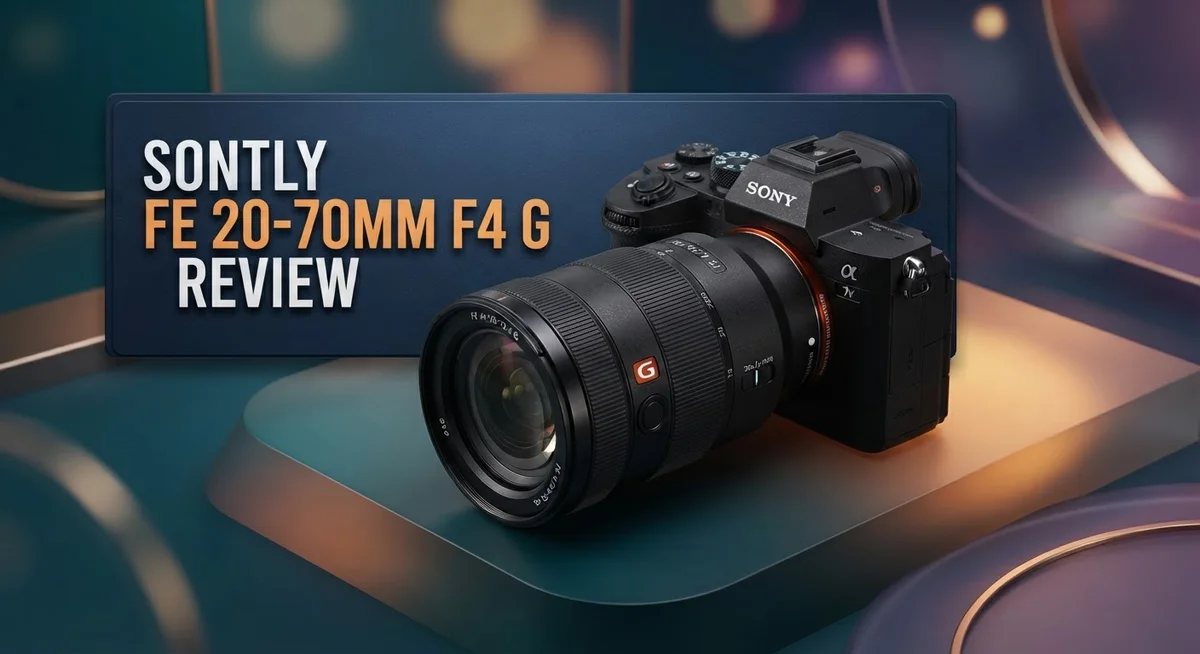
Sony FE 20-70mm F4 G Lens Review: Specs, Performance & Comparison
Looking for a lens that does it all? The Sony FE 20-70mm F4 G might be your answer.
This lens covers ultra-wide to mid-tele in one package. It replaces two lenses with a single, smart tool.
Photographers love its exceptional sharpness. Every shot stays crisp, from corner to corner.
The compact design makes travel easy. You get a lightweight lens that fits any bag.
Smooth zoom action means no annoying creep. You can trust it during long shoots.
This lens shines for landscape and architecture work. It also handles everyday travel shots with ease.
Sure, it has a fixed F4 aperture. It also skips built in stabilization.
But does that stop it from being a top choice? Let’s find out in this detailed Sony FE 20-70mm F4 G review.
In a Nutshell
Here’s the quick rundown on what makes this lens special.
-
One lens, many uses. The Sony FE 20-70mm F4 G replaces two lenses in your bag. You get ultra-wide framing and mid-tele reach without swapping glass.
-
Sharpness stays consistent. Image quality holds up across the entire zoom range. Corners stay crisp even at 20mm.
-
Built for movement. The zoom ring feels smooth and damped. You won’t fight zoom creep during hikes or shoots.
-
Light enough to forget. Its compact body makes long travel days easier. Your neck and shoulders will thank you.
-
Missing image stabilization. This lens skips built in stabilization. You’ll rely on body stabilization or steady hands instead.
-
Aperture stays fixed at F4. It won’t blur backgrounds like an F2.8 lens. Low light shooters may need to boost ISO more often.
-
Best fit for certain shooters. Landscape, architecture, and travel photographers benefit most. Sports or wildlife shooters may want more reach.
This lens trades some speed for versatility and portability. For everyday shooting, that trade often pays off.
Optical Performance and Sharpness
The Sony FE 20-70mm F4 G delivers outstanding optical performance across its entire focal range. This lens maintains sharp details from edge to edge, whether you shoot at 20mm or 70mm. The sharpness remains consistent throughout the zoom range, which is rare in compact travel lenses.
At the ultra-wide 20mm end, you get crisp corner-to-corner clarity. This makes the lens perfect for landscape photography where every detail matters. The mid-range performs equally well for standard compositions. At 70mm, the telephoto reach still holds impressive sharpness without any softness creeping in.
The G Lens designation means Sony applied their premium optical standards here. You’ll notice reduced chromatic aberration in high-contrast scenes. Color fringing stays minimal even when shooting against bright skies. Distortion control is excellent for a zoom lens at this focal length spread.
Contrast and color rendering feel natural and punchy. Skin tones look accurate for portrait work at the longer end. Landscape colors pop without appearing oversaturated. The lens handles backlighting situations well, with minimal flare or ghosting issues.
One thing to note: the fixed F4 aperture means less background blur compared to faster lenses. This isn’t a weakness for optical performance. It simply reflects the lens design philosophy. If you need shallow depth of field, you’ll need a faster alternative.
The constant aperture helps maintain consistent exposure as you zoom. This matters for video work and fast-moving photography. You won’t need to adjust settings when zooming through your shot.
Internal focusing keeps the front element stationary. This prevents image quality loss and helps with filter use. The optical formula uses advanced glass elements to minimize aberrations.
Real world testing shows the lens performs best in good light conditions. Outdoor photography yields exceptional results. Indoor low-light situations show the limitations of the F4 aperture, but optical performance itself remains sharp.
For travel, landscape, and architecture work, this lens delivers the optical quality you’d expect from a premium G series lens. The sharpness advantage over older 24-70mm options is noticeable in direct comparisons.

- Sony USA Authorized. Bundle Includes: Sony FE 20-70mm f/4 G Lens (Sony E), 72mm Filter Kit, Lens...
- Versatile wide-to-standard zoom lens offering a constant F4 aperture across the zoom range. Ideal...
- Advanced optical design includes two AA and three ED elements to reduce distortion and chromatic...
Last update on 2026-11-07 / Affiliate links / Images from Amazon Product Advertising API
Design, Build Quality, and Portability
The Sony FE 20-70mm F4 G feels like a purpose built travel companion. Its compact frame sits comfortably in camera bags without dominating space. The lens weighs surprisingly little, making all day shooting sessions feel effortless.
The build quality reflects Sony’s G Lens commitment. Metal construction throughout the barrel inspires confidence. The zoom ring turns with precision and zero wobble. You won’t find cheap plastic here.
The zoom action deserves special mention. The damped mechanism feels intentional and controlled. Zoom creep simply doesn’t happen. Whether you point the lens up or down, it stays exactly where you set it. This matters during video work and long exposure shots.
The exterior coating resists fingerprints and dust effectively. Sony applied their premium finishes across the entire body. The focus ring spins smoothly without grinding or resistance. Every control feels deliberate and well engineered.
Portability stands out as a major strength. This lens replaces what would normally require two separate lenses in your bag. The 20 70mm range covers ultra wide landscape shots through mid telephoto framing. You get genuine versatility without carrying extra weight or bulk.
The compact design doesn’t sacrifice handling. The grip area provides enough space for secure control. Your fingers won’t feel cramped during extended shooting. The balance on full frame Sony bodies feels natural and centered.
Weather sealing gets a mention here. The lens features dust and moisture resistance. You can shoot in light rain or dusty environments without constant worry. This adds to its appeal for travel and outdoor work.
The front element remains stationary during focusing and zooming. This design choice protects your filter and keeps the overall package stable. No internal extension means the lens maintains its compact profile throughout the zoom range.
Photographers moving from older Sony lenses immediately notice the refinement. The mechanical feel surpasses previous generation designs. Everything moves with purpose and precision. The lens feels like it will outlast years of regular use.
For content creators, videographers, and photographers seeking one reliable companion lens, the build quality and portability combination delivers real value. You get professional construction in a package light enough for genuine travel convenience.
Focal Range Versatility and Use Cases
The 20-70mm focal range opens doors to shooting scenarios that normally require two separate lenses. You capture ultra-wide landscapes at 20mm, then zoom to 70mm for tighter framing without changing glass. This flexibility matters most when you’re moving fast.
Landscape photographers love this range. Wide angles grab expansive vistas, while the 70mm end compresses distant mountains and creates depth. You stay in one spot and adjust composition by zooming instead of walking backward.
Architecture benefits from the ultra-wide 20mm start. Buildings fit into frames without distortion creep that happens with extreme wide angles. The 70mm end lets you isolate details and patterns on facades from a distance.
Travel shooting becomes simpler. One lens covers street photography, environmental portraits, and scenic shots. Your camera bag stays light, and you spend less time swapping glass. The constant F4 aperture means exposure stays stable as you zoom through scenes.
Videography gains from smooth zoom transitions. The damped zoom ring prevents accidental movement, and internal focusing keeps the front element still. This matters when you’re recording and can’t afford focus breathing distractions.
Street photographers appreciate the 20-70mm span. Wide enough to capture context and environment, long enough to frame subjects without getting too close. The compact size lets you move through crowds without drawing attention.
Real estate and interior work fits well here. The 20mm handles tight rooms, while 70mm works for detail shots and exterior views. You cover most scenarios without switching lenses constantly.
One limitation exists: the 70mm maximum. If you shoot telephoto work regularly, you’ll want additional focal length. Wildlife and distant sports need longer reach.
The F4 constant aperture means you won’t achieve shallow depth of field like faster lenses. Low light situations require higher ISOs or slower shutter speeds. This isn’t a lens for background separation or extreme bokeh effects.
The real strength lies in versatility for photographers who value simplicity and portability over extreme capabilities. This lens solves the question of “what single zoom should I carry?” for most general shooting needs.
Top 3 Alternatives
Tamron 17-70mm F/2.8

- INCLUDED – Complete Creator Lens Bundle: Tamron 17-70mm f/2.8 Di III-A VC RXD Lens | Lens Hood...
- VERSATILE APS-C POWER ZOOM – 17-70mm range with 25.5-105mm full-frame equivalent covers wide-angle...
- BRIGHT F/2.8 + BEAUTIFUL BOKEH – Constant f/2.8 aperture delivers strong low-light performance and...
Last update on 2026-11-07 / Affiliate links / Images from Amazon Product Advertising API
This lens gives you a wider starting point than the Sony. You get 17mm instead of 20mm, which helps in tight spaces. The constant f/2.8 aperture means more light reaches your sensor at every focal length. This makes low-light shooting easier and gives you better background blur control.
The Tamron feels lighter in your hand. Its autofocus runs quietly, perfect for video work. You’ll notice sharper images at the edges compared to many zoom lenses in this class.
Sigma 18-50mm F2.8

- SMALL AND LIGHT
- Versatile Focal range and ecellent optical Performace
- Superb Optical Quality
Last update on 2026-11-07 / Affiliate links / Images from Amazon Product Advertising API
Sigma’s option covers a similar range with that same f/2.8 constant aperture. The 18mm wide angle performs well for landscapes and architecture. The lens handles close focusing nicely, letting you capture small details without switching equipment.
Build quality impresses here. The lens feels solid and weather-sealed. Image stabilization helps when you’re shooting handheld in dim conditions. Colors come out punchy and natural.
Sony FE 24-105mm F4

- Items Include : 1 x Sony FE 24-105mm f/4 G OSS Lens, 1 x 77mm 3 Piece Filter Kit, 1 x Lens Cap...
- Designed for versatility, the FE 24-105mm f/4 G OSS Lens from Sony is a wide-angle to...
- Covering a versatile wide-angle to short-telephoto range, this 24-105mm lens is designed for...
Last update on 2026-11-08 / Affiliate links / Images from Amazon Product Advertising API
This Sony extends your reach further than the 20-70mm. You get more telephoto range for distant subjects. The f/4 aperture stays consistent throughout, keeping your exposure settings predictable.
The 24-105mm covers most shooting situations in one lens. You won’t need to swap lenses as often. Weight and size stay reasonable for all-day shooting. Image quality remains sharp across the frame, even at maximum zoom.
All three alternatives offer different strengths. Choose based on whether you want wider angles, constant fast apertures, or extended zoom range.
Zoom Mechanism and Handling
The zoom mechanism on this lens operates with smooth, controlled precision. You’ll notice the damping feels deliberate and purposeful. The rotation spins from 20mm all the way to 70mm without any wobble or looseness. This consistency matters because zoom creep (where the lens extends on its own) simply doesn’t happen here.
The barrel itself rotates smoothly during zooming. Your hand naturally finds a comfortable grip position. The zoom ring has just enough resistance to prevent accidental shifts while remaining easy to adjust. This balance makes it practical for both handheld shooting and tripod work.
Handling characteristics shine during extended shooting sessions. The lens remains balanced in your palm throughout the entire focal range. Weight distribution feels natural whether you’re at 20mm or 70mm. The compact profile means your arm doesn’t fatigue quickly, which matters for travel days or video work.
The focus ring sits separately from the zoom ring, preventing confusion during operation. Internal focusing means the barrel length stays constant. You won’t accidentally bump the front element while adjusting focus or zooming. This design choice improves reliability and reduces the chance of dust entering the lens.
One-handed operation works reasonably well, though two hands give you better control. The zoom ring width provides enough surface area for precise adjustments. You can make small focal length changes without excessive rotation.
Switching between autofocus and manual focus happens instantly. The AF motor responds quickly to your input. Manual focus feels responsive when you need direct control.
The lens feels professional without being unnecessarily heavy. Photographers upgrading from older zoom lenses immediately appreciate the refinement in the zoom action. The mechanism shows Sony’s attention to engineering details.
For video creators, the smooth zoom motion translates to cinematic results. The damped action prevents jerky transitions between focal lengths. This makes the lens appealing for vlogging, documentaries, and creative projects requiring smooth focal shifts.
The overall handling experience demonstrates that compact design doesn’t mean compromising on control. Every element works together to create an intuitive shooting experience.
Aperture Limitations and Low-Light Performance
The F4 constant aperture represents both a practical choice and a genuine limitation for photographers working in challenging light conditions. This fixed aperture means the lens maintains consistent exposure settings across the entire 20-70mm range, which simplifies exposure metering but restricts your creative options in darker environments.
Low-light performance takes a hit compared to faster alternatives. When you’re shooting indoors, during golden hour, or in overcast conditions, the F4 aperture requires you to increase ISO sensitivity or slow your shutter speed. This trade-off becomes noticeable when handheld shooting in dim venues or when you want faster shutter speeds for moving subjects.
The lack of optical stabilization compounds this limitation. Without built-in image stabilization, you depend entirely on steady hands or tripod support to avoid motion blur at slower shutter speeds. For video work in low light, this absence becomes more pronounced than in still photography.
That said, the lens still delivers acceptable results in moderate low-light situations. Modern Sony camera bodies offer excellent high-ISO performance, which helps compensate for the F4 restriction. At ISO 1600 or 3200, you can still achieve clean images on current full-frame Sony cameras.
The F4 aperture also affects depth-of-field control. You won’t achieve the dramatic background separation that faster F2.8 lenses provide. For portrait work or isolating subjects from busy backgrounds, this becomes a real constraint. Landscape and architecture photographers notice this limitation less since they typically prefer deeper depth of field anyway.
Understanding your shooting environment matters here. If you primarily shoot outdoors during daylight hours, the F4 aperture poses minimal problems. Travel photographers and landscape enthusiasts rarely encounter issues. However, event photographers, studio workers, or anyone shooting regularly in dim indoor spaces should consider faster alternatives like the Tamron 28-75mm F2.8 option.
The lens excels at what it’s designed for: versatile, portable shooting in well-lit or moderately-lit conditions. Expecting fast aperture performance from this compact design sets unrealistic expectations. The F4 limitation represents a deliberate design choice that prioritizes portability and sharpness over extreme low-light capability.
Pros and Cons
Pros
- Delivers sharp, detailed images from 20mm all the way to 70mm without quality drops
- Replaces two lenses (ultra-wide and standard zoom) in one compact package
- Zoom ring stays put with zero creep, plus smooth damped mechanism feels premium
- Lightweight and portable design makes it perfect for travel and hiking trips
- Professional G Lens quality ensures consistent color and contrast across the entire range
Cons
- Maximum 70mm focal length limits reach for distant subjects or tight framing
- F4 fixed aperture restricts shallow depth of field and struggles in dim indoor lighting
- No optical stabilization means you’ll need steady hands or a tripod in low light situations
Who Should Buy It
This lens works best for photographers who value versatility and portability above all else. If you shoot landscapes, architecture, and travel photography, the 20-70mm range covers almost everything you need in a single package.
Content creators and vloggers benefit from the smooth, damped zoom mechanism. The lens delivers cinematic zoom motion without any stuttering or jerky transitions. Your videos will look professional without requiring expensive stabilization gear.
You should consider this lens if you prioritize image quality and sharpness. The G Lens standard means every shot maintains excellent color accuracy and contrast from 20mm to 70mm. Professional photographers appreciate this consistency across the entire focal range.
Hiking enthusiasts and backpackers love this option. The compact, lightweight design means you can carry it all day without fatigue. You get ultra-wide to mid-telephoto coverage without the weight penalty of larger zoom lenses.
This lens suits photographers who work primarily in daylight or well-lit environments. The F4 aperture handles outdoor shooting beautifully. If you mostly shoot during golden hour or sunny conditions, the fixed aperture won’t limit your creative options.
You’re a good match if you already own a Sony E-mount camera and want to expand your lens collection. The seamless autofocus performance and instant manual focus switching integrate perfectly with modern Sony bodies.
Skip this lens if you need fast aperture performance. The F4 limitation makes it unsuitable for shallow depth of field portraits or serious low-light work. Professional studio photographers should look elsewhere.
This isn’t the right choice if you need telephoto reach beyond 70mm. Wildlife and sports photographers require longer focal lengths. The maximum 70mm focal length can feel restrictive when photographing distant subjects.
You should also reconsider if optical stabilization is essential for your work. The lack of built-in stabilization means handheld video requires steady hands or external support. Tripod users won’t notice this limitation, but handheld shooters might struggle in dim conditions.
Overall, this lens excels for photographers seeking a reliable, sharp, and portable all-in-one solution for everyday shooting.
Final Verdict
The Sony FE 20-70mm F4 G stands out as a smart choice for photographers who want one lens that does it all. Its combination of sharp optics and a flexible focal range makes it a strong everyday companion.
This lens shines brightest for people who value convenience over specialized performance. It handles landscapes, architecture, and travel photography with ease.
Compared to the older Sony FE 24-70mm F4 ZA OSS, this newer lens offers better sharpness and a wider starting point at 20mm. Many users find it a clear upgrade.
Against the Sony FE 24-105mm F4, the 20-70mm often wins on size and weight. It packs similar quality into a smaller body, which matters a lot during long shooting days.
If you need a faster aperture for low light or portraits, the Tamron 28-75mm F2.8 might serve you better. That lens trades focal range for speed.
But if versatility and portability top your list, this Sony G lens makes a lot of sense. It fits naturally into a travel bag or a daily camera setup.
Think about how you shoot before deciding. Outdoor photographers and content creators will likely appreciate this lens the most.
Studio photographers or those needing shallow depth of field for portraits might want to look elsewhere. The F4 aperture simply cannot compete with faster lenses in that specific area.
Overall, this lens delivers on its promise of quality and flexibility. It replaces multiple lenses with one compact solution, which simplifies your kit.
For most Sony shooters, this lens earns a solid recommendation. It balances image quality, portability, and practical focal range better than most alternatives on the market today.
Choose this lens if your photography style matches its strengths. Skip it only if you have very specific needs that fall outside its capabilities.
Frequently Asked Questions
Does this lens work with full-frame Sony cameras?
Yes, the Sony FE 20-70mm F4 G is designed for Sony E-mount full-frame cameras. It pairs perfectly with models like the Sony A7 series. The lens also works on Sony APS-C bodies, though the focal length will shift due to the crop factor.
What makes the 20-70mm range special compared to other zooms?
This focal range starts at 20mm, which is ultra-wide. Most standard zooms begin at 24mm or 28mm. You get wider landscape shots without needing a separate ultra-wide lens. The range extends to 70mm for light telephoto work. One compact lens replaces what typically requires two separate zooms.
Can I use this lens for portraits?
The 70mm focal length works for portraits, but the F4 aperture limits background blur. You won’t achieve the shallow depth of field that faster lenses provide. Portraits will look sharp and detailed, but the background separation won’t be dramatic. This lens excels more for environmental portraits and group shots.
Why doesn’t this lens have image stabilization?
The compact design was a priority for Sony engineers. Adding optical stabilization would increase size and weight. The lightweight form factor appeals to travel photographers. In bright daylight, you won’t miss stabilization. Low light situations require a tripod or very steady hands.
Is the F4 aperture a real limitation?
It depends on your shooting style. For daylight landscape and architecture work, F4 is plenty. Indoor events or portraits in dim settings become challenging. If you shoot mostly outdoors, F4 feels natural. Photographers who need faster aperture performance should explore the Tamron 28-75mm F2.8 alternative instead.

DK is a tech enthusiast and product reviewer dedicated to helping readers explore the ever-evolving world of technology. With a passion for testing gadgets, apps, and appliances, DK delivers honest, in-depth reviews and practical buying guides to make your tech decisions easier.