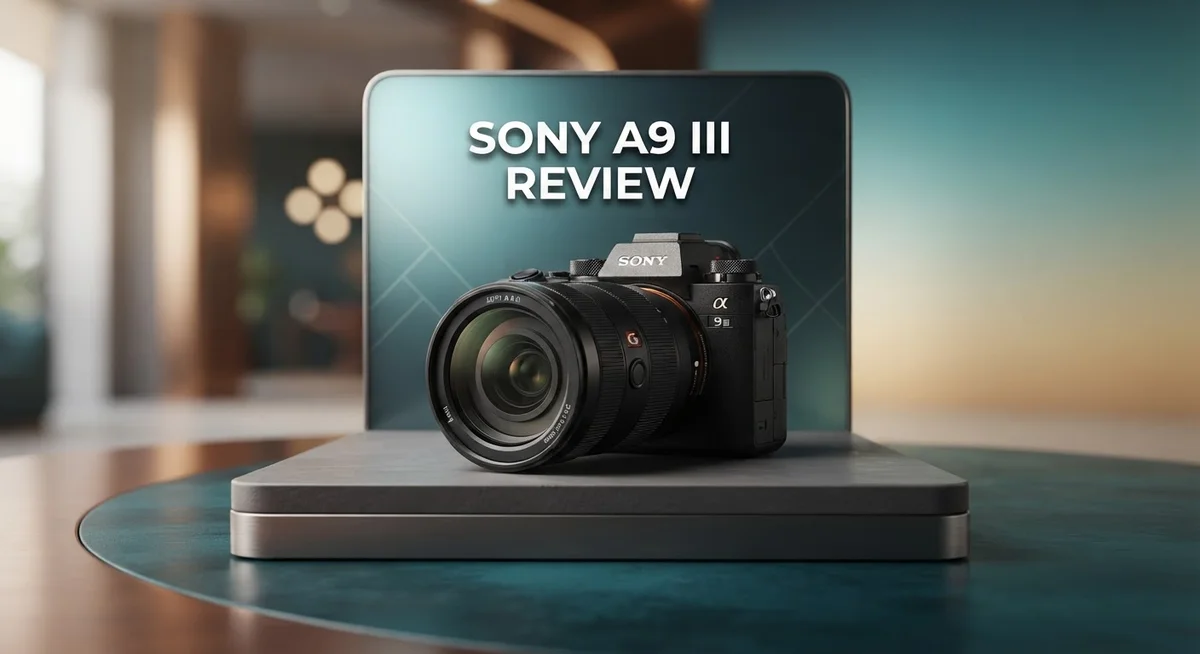
Sony A9 III Review: Full-Frame Mirrorless Camera with Global Shutter
The Sony A9 III changes the game for speed lovers. It brings the world’s first full frame global shutter to life.
This sensor lets you shoot at 120 fps with full autofocus tracking. You get zero blackout while shooting. Every frame stays clear and sharp.
Fast moving subjects no longer cause distortion. The global shutter fixes rolling shutter issues for good. Sports and action shooters will notice this instantly.
This camera also syncs flash at any shutter speed, up to 1/80,000s. That opens new doors for creative flash photography.
We tested the A9 III to see how it performs in real world use. This review covers its autofocus, image quality, and build design.
You will learn where this camera shines. You will also see where it falls short compared to the Sony A1 and other rivals. Let’s jump into what makes the A9 III special.
In a Nutshell
Here’s the quick rundown on the Sony A9 III for anyone short on time.
- Sensor resolution sits at 24.6MP, lower than the A1 lineup. You get less fine detail in large prints or heavy crops.
- The autofocus system tracks subjects with impressive accuracy. Sports and wildlife shooters will notice the difference right away.
- Weather sealing feels solid in every condition we tested. Rain, dust, and cold weather did not slow this camera down.
- In body image stabilization helps handheld shots stay sharp. This matters most in low light or with longer lenses.
- This camera truly shines for off camera flash photography. The global shutter removes the usual sync speed limits other cameras face.
- Compared to the Sony A1 and Canon R5 II, the A9 III trades resolution for pure speed. It is a specialist tool, not an all rounder.
If you shoot fast action or rely on flash work, this camera fits your needs well. If detail and resolution matter more, look at other models in the lineup.
Sensor and Image Quality
The Sony A9 III uses a 24.6MP full frame stacked CMOS sensor that delivers clean, sharp images even in demanding situations. This sensor sits at the heart of what makes this camera special for professionals who need reliability and speed combined.
Global shutter technology is the real star here. Sony packed the world’s first full frame global shutter into this body, meaning every pixel captures light at the same moment. You get zero distortion when shooting fast moving subjects or using flash. Traditional cameras with rolling shutters can bend or skew action. The A9 III eliminates this problem entirely.
The stacked sensor design matters too. It allows the camera to read data faster without generating heat or noise. You notice this in high speed bursts where image quality stays consistent from frame one to frame 120. The sensor doesn’t struggle or overheat during long shooting sessions.
Dynamic range performs well across different lighting conditions. Shadows retain detail without becoming muddy, and highlights don’t blow out as easily as you might expect. RAW files give you plenty of room to adjust exposure in post production. JPEG output looks natural and balanced straight from the camera.
Noise handling deserves mention. At ISO 100 to 3200, the A9 III produces clean files with minimal grain. Push to ISO 6400 and you still get usable images. Higher ISOs show more noise, but it stays manageable for most professional work. The sensor doesn’t sacrifice image quality for its speed capabilities.
One trade off exists worth noting. The 24.6MP resolution means less fine detail compared to higher megapixel cameras like the Sony A1 II. Massive prints or heavy cropping reveal this limitation. However, for most professionals shooting action, sports, or events, this resolution handles the job without issues.
The sensor excels at flash synchronization too. You can sync flash at 1/80,000s shutter speed, opening creative possibilities unavailable on other cameras. This changes how you approach off camera lighting in bright daylight.

- World's First Full Frame Global Shutter: The Alpha 9 III features the world’s first full-frame...
- Blackout-free, 120fps Continuous Shooting: The Alpha 9 III is defined by speed and accuracy...
- Preserve Split-second Moments: At 1/80,000 second maximum shutter speed, the Alpha 9 III makes it...

Last update on 2026-11-08 / Affiliate links / Images from Amazon Product Advertising API
Autofocus and Shooting Performance
The autofocus system on the A9 III performs exceptionally well in demanding situations. Real-time eye tracking keeps focus locked on subjects even when they move unpredictably. The camera maintains focus accuracy at 120 fps, which is no small feat.
Continuous shooting reaches 120 fps with full autofocus and autoexposure tracking active. This means you never miss the decisive moment. The blackout-free viewfinder lets you see exactly what happens as it happens.
Subject detection works across multiple categories. The camera recognizes people, animals, birds, insects, and vehicles automatically. You can switch between these modes instantly, making it ideal for mixed shooting scenarios.
The global shutter eliminates distortion problems entirely. Traditional cameras with rolling shutters create skewed images when subjects move fast. The A9 III avoids this completely, even at extreme shutter speeds.
Flash synchronization reaches 1/80,000s, which opens creative possibilities other cameras cannot match. You can use flash in bright sunlight without neutral density filters. This capability alone changes how you approach fill light and off-camera flash work.
Autofocus sensitivity adjusts to your shooting style. You can fine-tune how quickly the camera responds to focus changes. This flexibility prevents false focus shifts during unpredictable movement.
The phase detection autofocus system covers 99 percent of the frame. Edge-to-edge coverage means subjects anywhere in your composition stay sharp. No dead zones exist where focus struggles.
Continuous autofocus tracking performs reliably with fast moving subjects. Athletes, wildlife, and vehicles stay locked throughout sequences. The system predicts subject movement and adjusts focus preemptively.
AF performance in low light remains strong. The camera maintains tracking even as light drops significantly. This matters for indoor sports and event photography.
Shooting speed combines with autofocus accuracy to deliver results other cameras cannot achieve. The A9 III prioritizes speed and precision equally, making it a specialist tool for professionals who demand both. Whether you shoot sports, wildlife, or fast-paced events, the autofocus system keeps pace with your vision.
Design, Build Quality, and Weather Resistance
The Sony A9 III features a robust magnesium alloy body that feels premium in your hands. The construction quality stands out immediately when you pick up the camera. Sony engineered this body to withstand professional use in challenging environments.
Weather sealing protects the camera against dust and moisture intrusion. Gaskets seal critical joints throughout the body. The battery compartment and card slots receive special attention for protection. This means you can shoot in light rain or dusty conditions with confidence.
The fully articulated LCD screen adds practical value to your workflow. You can flip the screen toward yourself for vlogging or tilt it for overhead shots. The hinge mechanism feels sturdy and moves smoothly without wobbling. This flexibility matters when you shoot from unusual angles.
The grip ergonomics work well for extended shooting sessions. Your fingers rest naturally on the shutter button and control dials. The textured surface prevents slipping even with wet hands. The overall feel communicates durability and professional intent.
Button placement follows Sony’s familiar layout. The custom function buttons let you assign controls to your preferred settings. The mode dial clicks satisfyingly between positions. Dedicated dials for shutter speed and exposure compensation sit within easy reach.
The camera’s weight distribution feels balanced with most lenses attached. The stacked sensor design keeps the internal layout compact despite advanced technology. This contributes to the relatively lightweight body compared to competitors.
Port placement includes USB Type C for charging and data transfer. HDMI and headphone jacks sit on the side for video work. The design keeps cables from interfering with your grip during shooting.
The shutter mechanism operates silently thanks to the global shutter design. You’ll notice this immediately in quiet environments like weddings or wildlife situations. Traditional cameras produce audible shutter noise that can disrupt moments.
Overall, the A9 III demonstrates thoughtful engineering in every detail. The build quality reflects Sony’s commitment to professional standards. Weather resistance gives you freedom to shoot in real world conditions without constant worry. This camera rewards photographers who demand reliability in their equipment.
Top 3 Alternatives
Canon EOS R5

- High Image Quality: Canon EOS R5 8K digital camera features a stacked, back-side illuminated...
- Powerful Image Processor: DIGIC X image processor with an ISO range of 100-51200; expandable to...
- High-Speed Shooting: High-speed continuous shooting of up to 12 fps with mechanical shutter and up...
Last update on 2026-11-08 / Affiliate links / Images from Amazon Product Advertising API
The Canon EOS R5 stands out as a professional camera that delivers exceptional image quality. This camera features a 45-megapixel full-frame sensor that captures stunning detail in every shot. The autofocus system uses 1,053 AF points, making it easy to lock onto your subject quickly.
Video performance is where this camera truly shines. It records 8K video at 24fps and 4K at up to 120fps. The in-body image stabilization helps keep your footage smooth and steady. Canon’s color science produces natural-looking images that many professionals prefer.
The build quality feels solid and durable. Weather sealing protects your investment in challenging conditions. Battery life is respectable for a full-frame mirrorless camera.
Nikon Z9

- 45.7MP Stacked CMOS sensor and EXPEED 7 image processing. Fast powerful AF that can keep up with the...
- Subject detection uses deep learning to automatically detect and track people, cats, dogs, birds...
- Capture 45.7MP stills at 20 or 30 fps; 120 fps stills at 11MP, all with full AF and AE, and no...
Last update on 2026-11-08 / Affiliate links / Images from Amazon Product Advertising API
Nikon’s Z9 is a powerhouse built for serious photographers and videographers. The camera packs a 45.7-megapixel sensor that produces crisp, detailed images. Its 693-point autofocus system tracks moving subjects with impressive accuracy.
Video capabilities include 8K recording at 24fps and 4K at up to 120fps. The camera handles high frame rates without breaking a sweat. Nikon’s ergonomic design makes it comfortable during long shooting sessions. The viewfinder is bright and responsive, giving you a real-time preview of your scene.
The Z9 excels at fast continuous shooting, reaching up to 20fps with the mechanical shutter.
Panasonic Lumix S1H

- Items Include: Panasonic Lumix S1H Full Frame Digital Mirrorless Video Camera, 64GB SF-G TOUGH...
- Unmatched Image Quality with 24.2MP Full-Frame Sensor: Capture stunning photos and videos with the...
- 6K Video & Advanced 4K Recording for Cinematic Filmmakers: Take your video production to the next...
Last update on 2026-11-08 / Affiliate links / Images from Amazon Product Advertising API
Panasonic’s Lumix S1H focuses on video production above all else. This camera records 6K video internally, which gives you flexibility in post-production. The full-frame 24.2-megapixel sensor handles both stills and motion beautifully.
The camera offers excellent color grading options. Dual SD UHS-II card slots let you record longer without stopping. The compact design makes it lighter than some competitors, reducing fatigue during extended shoots. Panasonic’s interface feels intuitive to navigate.
Global Shutter Technology and Flash Sync Capabilities
The Sony A9 III brings something genuinely new to professional photography. Global shutter technology changes how you shoot in ways that matter immediately. Traditional cameras use rolling shutters, which scan from top to bottom. This creates distortion when subjects move fast or when you pan across a scene. The A9 III eliminates this problem entirely by capturing every pixel at the same instant.
This means no more skewed horizons in action shots. No more bent subjects when you track movement. Fast-moving sports, wildlife, and motorsport photographers feel the difference right away. The sensor captures light uniformly across the entire frame, giving you cleaner, more natural images every single time.
Flash synchronization reaches an extraordinary 1/80,000s shutter speed. Most cameras sync flash at 1/200s or 1/250s maximum. The A9 III lets you use flash in bright sunlight without stopping down your aperture. You can shoot at f/1.4 on a sunny beach and still trigger your flash. This opens creative possibilities that simply don’t exist on other cameras.
Off-camera flash work becomes more flexible too. You can use faster shutter speeds to control ambient light while your flash freezes the subject. Professional portrait photographers and studio specialists gain real advantages here. The combination of global shutter plus high-speed flash sync creates a powerful tool for controlled lighting situations.
The stacked CMOS sensor design works perfectly with these capabilities. It handles the rapid data processing needed for 120 fps continuous shooting while maintaining autofocus and autoexposure. The sensor reads information faster than traditional designs, which supports both the global shutter function and the extreme flash sync speed.
One consideration exists though. Global shutter sensors sometimes show slightly different noise characteristics at very high ISOs compared to rolling shutter alternatives. The A9 III manages this well, but it’s worth knowing. For most shooting situations, especially anything involving flash or fast action, this camera performs at a level few others can match.
Video Features and Stabilization
The A9 III handles video stabilization through Sony’s proven in-body image stabilization system. This tech reduces camera shake during handheld recording sessions. You get smoother footage without extra equipment or post-processing tricks.
The stabilization works across all video formats the camera supports. Sony integrated the system into the sensor itself. This means stabilization applies whether you shoot 4K or Full HD content. The system adapts to different focal lengths automatically.
Video recording capabilities focus on professional needs. The camera captures 4K video at various frame rates. You can record at 24p, 25p, 30p, 60p, and higher speeds depending on your format choice. Full HD recording offers even more frame rate flexibility for slow motion work.
The articulated LCD screen becomes valuable during video shooting. You can angle the display outward for easier framing when the camera sits on a tripod. This flexibility helps during interviews or stationary recording setups. The screen flips completely for selfie style recording too.
Audio handling matters for serious video work. The A9 III includes a 3.5mm microphone input jack. You can connect external microphones for better sound quality than the built-in option. Wind noise reduction features help clean up outdoor recordings.
The global shutter technology brings unexpected benefits to video work. Rolling shutter distortion disappears completely. Fast panning movements stay straight and clean. This advantage separates the A9 III from cameras using traditional shutters.
Battery life during video recording runs approximately 100 minutes on a single charge. This estimate depends on your specific recording settings and stabilization usage. You may want spare batteries for longer shooting days.
Heat management works reasonably well during extended recording sessions. The camera doesn’t impose artificial recording limits under normal circumstances. Professional users appreciate this reliability for critical assignments.
The combination of stabilization, frame rate options, and audio inputs makes the A9 III capable for video production. The global shutter adds another layer of technical advantage. These features work together to create a camera that handles both stills and motion effectively.
Pros and Cons
Pros
- Blackout free 120 fps shooting gives you zero interruption when tracking fast action
- Global shutter eliminates distortion that plagues traditional cameras during quick pans
- Flash sync reaches 1/80,000s, opening creative possibilities for off camera lighting
- Excellent weather sealing keeps dust and moisture out during tough conditions
- Strong autofocus system with 99% frame coverage locks onto subjects reliably
Cons
- Resolution sits at 24.6MP, which means less fine detail compared to the A1 II
- Global shutter technology limits your creative options in some specialized shooting scenarios
- Premium positioning places it above several other Sony full frame options in the lineup
Who Should Buy It
The Sony A9 III speaks directly to professional photographers and serious enthusiasts who demand speed and reliability. If you shoot fast-moving subjects, this camera becomes your ideal partner.
Sports photographers benefit most from the 120 fps continuous shooting with autofocus tracking. You capture every decisive moment without missing a single frame. The blackout-free viewfinder means you never lose sight of your subject during rapid sequences.
Wildlife photographers gain significant advantages too. The global shutter eliminates distortion when panning across unpredictable animal movement. You get clean, undistorted images even during your fastest tracking moments.
Event photographers working with off-camera flash systems find exceptional value here. The 1/80,000s flash sync speed opens creative lighting possibilities that other cameras cannot match. You control ambient light while using powerful strobes in daylight conditions.
Photojournalists appreciate the weather resistance and silent shutter operation. The global shutter runs completely silently, making it perfect for capturing candid moments without drawing attention. Dust and moisture protection keeps the camera functioning during challenging assignments.
Video professionals should consider this camera carefully. The 4K recording capabilities and in-body stabilization serve professional productions well. The articulated LCD screen helps during dynamic shooting angles. However, the 24.6MP resolution means you get less fine detail compared to higher resolution alternatives if stills matter equally to your work.
The A9 III is NOT ideal for photographers prioritizing maximum resolution. The A1 II offers significantly more megapixels if fine detail and large prints drive your needs. Studio photographers doing static product work may find the extra resolution more valuable.
This camera also suits hybrid creators who blend photography with videography. The combination of fast stills performance and solid video features makes it versatile for mixed media projects.
Ultimately, the A9 III targets those who value speed, reliability, and specialized capabilities like global shutter performance. If your work demands rapid shooting, flash flexibility, and silent operation, this camera delivers exactly what you need. Evaluate whether the 24.6MP resolution aligns with your output requirements before committing.
Final Verdict
The Sony A9 III stands as a groundbreaking camera for anyone who values speed and precision. Its global shutter technology changes how professionals think about capturing motion. This is not just another camera update. It marks a genuine shift in sensor design.
Photographers who chase fast moving subjects will find this camera transforms their workflow. The blackout free shooting experience feels different from anything else on the market. You stay connected to your subject without interruption.
That said, this camera makes sense for specific needs. If your work depends on capturing split second moments, the A9 III delivers results other cameras simply cannot match. Speed and reliability define this camera’s identity.
Photographers who need maximum resolution for large prints or heavy cropping should look elsewhere in the Sony lineup. The A9 III trades some detail for unmatched shooting speed. This tradeoff makes sense once you understand its purpose.
Think about your actual shooting style before deciding. Do you photograph fast action often? Does your work involve unpredictable movement? If yes, this camera solves real problems you face daily.
The camera also rewards photographers willing to learn new techniques. Global shutter capabilities open creative doors that did not exist before. Off camera flash work becomes simpler and more flexible.
Comparing this to competitors helps clarify its place. The Sony A1 II offers more resolution but lacks this shooting speed advantage. The Canon R5 II provides strong performance too, yet the A9 III’s global shutter remains unique in the full frame space.
Ultimately, the Sony A9 III serves a clear purpose. It excels for sports, wildlife, and event photographers who need dependable speed. Hybrid creators mixing photo and video work also benefit from its versatile features.
This camera does not try to be everything for everyone. Instead, it focuses on doing specific things exceptionally well. That focused approach makes it a smart choice for the right photographer.
Frequently Asked Questions
Does the Sony A9 III have a global shutter?
Yes, the Sony A9 III features a global shutter. This is the world’s first full-frame camera with this technology. A global shutter captures all pixels at the same moment, eliminating distortion you see in fast action shots. This matters most when you shoot moving subjects at high speeds or use off-camera flash.
The global shutter also enables flash sync up to 1/80,000s. You gain creative control with lighting that other cameras cannot match.
How many frames per second can it shoot?
The A9 III shoots at 120 fps continuous with autofocus and autoexposure tracking active. This speed lets you capture decisive moments without missing the shot. The blackout-free viewfinder means you see your subject the entire time you shoot.
This frame rate suits sports, wildlife, and fast-paced events perfectly.
What resolution does the A9 III offer?
This camera has a 24.6MP full-frame sensor. This resolution provides good detail for most professional work and prints. However, if you need maximum detail for heavy cropping or very large prints, the Sony A1 II offers higher resolution.
The 24.6MP sensor balances speed and image quality effectively.
How long does the battery last?
You get approximately 530 shots per charge. Battery life depends on your shooting habits, temperature, and whether you use the LCD screen or viewfinder. Carry a spare battery for full day shoots.
Is the A9 III weather sealed?
Yes, it has excellent weather resistance. The camera keeps dust and moisture out during tough conditions. This protection makes it reliable for outdoor work in challenging environments.

DK is a tech enthusiast and product reviewer dedicated to helping readers explore the ever-evolving world of technology. With a passion for testing gadgets, apps, and appliances, DK delivers honest, in-depth reviews and practical buying guides to make your tech decisions easier.