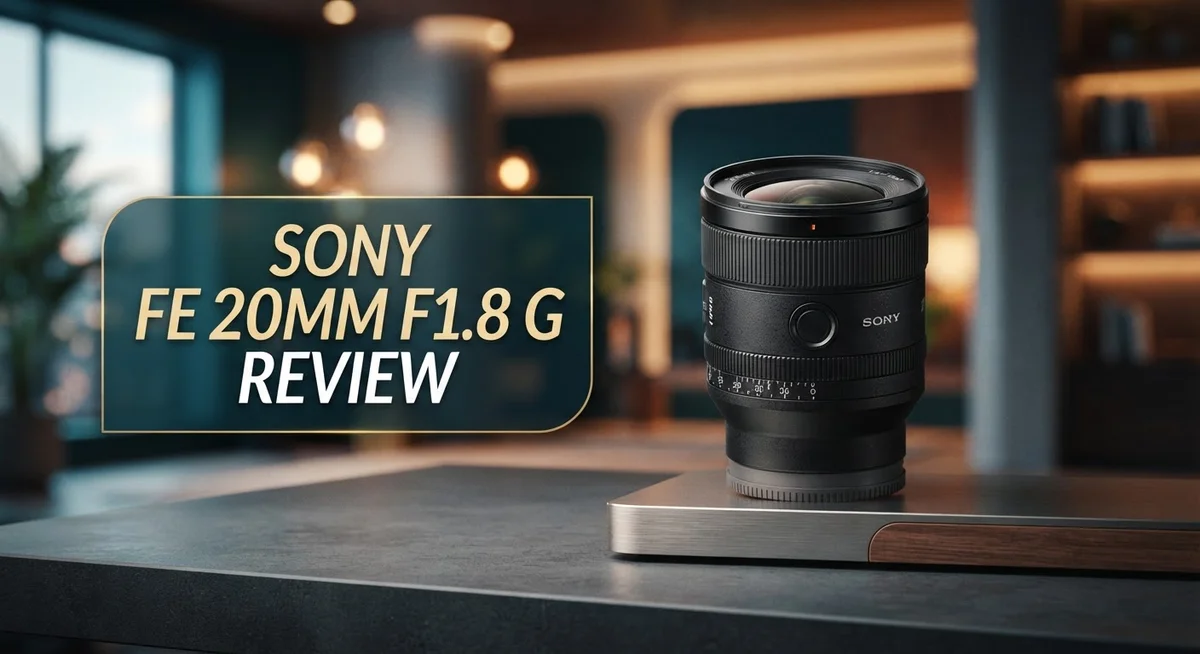
Sony FE 20mm f/1.8 G Review: Performance, Build Quality, and Astrophotography Capabilities
Looking for a wide angle lens that truly delivers? The Sony FE 20mm f/1.8 G might be your answer.
This lens packs serious optical power into a small body. It uses 14 elements in 12 groups. That includes 2 AA elements and 3 ED elements for crisp results.
Photographers love it for astrophotography. Landscape shooters also praise its wide, clean views. The f/1.8 aperture lets in plenty of light, even in dark settings.
Autofocus on this lens is fast and quiet. It stays sharp from corner to corner, even at its widest aperture. That is rare for a lens this size.
Sony built this lens with a fluorine coating on the front element. This helps repel water and dust. It also has a clickless aperture ring for smooth video work.
Want to know if this lens fits your kit? Let’s break down every detail below.
In a Nutshell
Here’s a quick summary of what makes this lens stand out.
-
Sharp Results Everywhere: This lens gives you corner to corner sharpness even at f/1.8. Your images stay crisp from center to edge.
-
Solid Build Quality: The lens body feels sturdy and compact. It resists dust and splashes, though it lacks full weather sealing.
-
Smart Optical Design: With 14 elements in 12 groups, this lens controls distortion well. The AA and ED elements work together to reduce chromatic aberration.
-
Flexible Aperture Control: You get a clickless aperture ring option for smooth video work. This feature helps filmmakers avoid audible clicks during exposure changes.
-
Some Trade-offs Exist: This lens skips physical function buttons. You also get limited options for switching between autofocus and manual focus modes.
-
Strong Competition Nearby: Lenses like the Sigma 20mm f/1.4 Art and Zeiss Loxia 21mm f/2.8 offer similar wide angle coverage. Each brings different strengths to the table.
This lens suits photographers who want reliable performance in a small package. It handles wide scenes and night skies with confidence.
Optical Design and Lens Elements
The Sony FE 20mm f/1.8 G uses a sophisticated optical formula to achieve its impressive performance. Sony engineered 14 elements arranged in 12 groups to control aberrations and deliver consistent image quality across the entire frame.
The lens features 2 Advanced Aspherical elements that reduce spherical aberration. This design choice allows the lens to maintain sharpness even when you shoot wide open at f/1.8. You get clean, distortion free images without stopping down.
Sony also included 3 ED (Extra low Dispersion) glass elements in the optical path. These elements minimize chromatic aberration, especially noticeable when you photograph high contrast subjects against bright skies. The result is color accuracy from edge to edge.
The front element receives a fluorine coating that repels dust, water droplets, and fingerprints. This coating makes cleaning easier and protects the glass surface during outdoor shoots. You spend less time maintaining the lens and more time shooting.
The aspherical elements work together to keep distortion minimal. Wide angle lenses naturally introduce barrel distortion, but Sony’s design keeps this effect well controlled. Your straight lines stay straight, whether you frame architecture or landscapes.
The optical construction also supports the lens’s fast autofocus performance. The internal focusing mechanism moves only certain elements rather than the entire lens barrel. This approach reduces focus hunting and keeps operation silent on camera.
Sony optimized the element spacing and glass types specifically for mirrorless shooting. The optical design accounts for how Sony’s sensors capture light rays coming directly from the rear elements. This optimization contributes to the corner to corner sharpness you see in real world use.
The compact size results from careful optical engineering. Sony managed to fit this complex formula into a small, lightweight body without sacrificing image quality. Photographers appreciate carrying less weight while maintaining professional grade optical performance.
The optical design balances multiple priorities. You get fast aperture performance, excellent sharpness, minimal distortion, and a portable package. This balance makes the lens practical for travel, astrophotography, and everyday wide angle work.

- Compact ultra-wide prime G lens w/ stunning wide-open resolution
- F1.8 max aperture provides extraordinary exposure and depth of field
- Compact, lightweight design, ideal for both full-frame and APS-C2 cameras

Last update on 2026-11-08 / Affiliate links / Images from Amazon Product Advertising API
Autofocus Performance and Handling
The autofocus system on this lens delivers fast and silent operation that makes it a joy to use in real world shooting. Sony’s autofocus motor responds quickly to subject movement, whether you’re tracking wildlife or locking onto distant stars. The quiet performance means you won’t hear distracting motor noise during video recording or quiet moments.
One thing to note: this lens lacks physical autofocus and manual focus toggle buttons on the barrel. You’ll need to switch between modes using your camera’s menu system or custom buttons. Some photographers find this slightly inconvenient, but it keeps the lens body slim and lightweight.
The autofocus system works exceptionally well across the entire frame. You get reliable focus acquisition from edge to edge, even when shooting at the wide f/1.8 aperture. This makes the lens excellent for fast paced situations where you need instant focus confirmation.
Manual focus operation feels smooth and responsive. The focus ring turns with consistent resistance that gives you good tactile feedback. You can make fine adjustments easily without accidentally shifting focus too far. This precision helps when you’re composing carefully framed shots.
The compact size and lightweight design make handling this lens a genuine pleasure. It balances beautifully on most Sony mirrorless bodies without feeling front heavy. The lens sits so close to the camera that it feels like a natural extension of your kit. This makes it perfect for handheld shooting in low light or during long astrophotography sessions.
The dust and splash resistant construction adds confidence when you’re working in challenging conditions. While the lens lacks full weather sealing, the protective coatings and sealed construction keep dust and moisture away from internal elements. This durability means you can shoot confidently in light rain or dusty environments.
Overall, the autofocus and handling experience feels refined and user friendly. The lens responds exactly as you expect it to, with no surprises or frustrations during actual use. Whether you’re shooting video, stills, or astrophotography, this lens handles everything smoothly and reliably.
Image Quality and Sharpness Across the Frame
The Sony FE 20mm f/1.8 G delivers exceptional sharpness across the entire frame, even when you shoot wide open at f/1.8. This performance is rare for a fast wide angle lens. Most lenses show softness in the corners at maximum aperture, but this one stays crisp from edge to edge.
The optical design makes this possible. Two Advanced Aspherical elements work to eliminate spherical aberration that typically causes corner softness. This means you get clean, detailed images in every part of your frame. The three ED glass elements further refine the image by reducing color fringing and chromatic aberration.
At f/1.8, the center sharpness is outstanding. Fine details pop with clarity. You can shoot landscapes, architecture, or close subjects with confidence. The lens maintains its sharpness consistency as you stop down to f/2.8, f/4, and beyond. There’s no surprise softness hiding anywhere in the frame.
Distortion control is another strength. The aspherical elements keep barrel distortion minimal, so straight lines stay straight. This matters for architectural photography and wide landscape shots. You won’t spend hours correcting warped horizons in post production.
The fluorine coating on the front element protects image quality too. Dust and water droplets don’t stick to the glass. This keeps your shots clean and prevents haze or reflections from ruining your images. In harsh environments, this coating makes a real difference.
Contrast and color rendition feel natural throughout the frame. Blacks stay deep. Highlights retain detail. Color accuracy remains consistent from center to corners. The overall micro contrast is excellent, giving images a punchy, three dimensional feel.
One thing to note: sharpness at very close focus distances shows slight softening in the corners, but this is normal for wide angle lenses. For most shooting scenarios, this lens performs at a level that rivals much more expensive optics. Whether you’re capturing stars, landscapes, or architectural details, the Sony FE 20mm f/1.8 G delivers the image quality you need.
Top 3 Alternatives
Tamron 20mm f/2.8 Di III
No products found.
The Tamron lens offers a solid alternative for Sony E-mount users. This lens delivers sharp images across the frame with minimal distortion. The f/2.8 aperture provides adequate light gathering for most shooting situations. Autofocus performance is reliable and quiet, making it good for video work. The compact design makes it easy to carry in your camera bag. Build quality feels sturdy and professional. You get a macro focusing capability that lets you get closer to subjects than many competitors.
Sigma 16mm f/1.4 DC DN

- Bundle Includes: Sigma 16mm f/1.4 Contemporary DC DN Prime Lens (Sony E), Corel Bundle of Photo...
- Large Aperture f/1.4: Ideal for low light performance and beautiful background blur
- Smooth Autofocus: Stepping motor supports fast, quiet focusing for video and stills
Last update on 2026-11-08 / Affiliate links / Images from Amazon Product Advertising API
Sigma’s wide-angle option stands out with its faster f/1.4 aperture. This extra light-gathering power helps in low-light environments and creates shallow depth of field effects. The 16mm focal length is slightly wider than the Sony, giving you more coverage. Image quality is excellent with good contrast and color rendition. The lens feels well-built and balanced on most camera bodies. Autofocus is snappy and accurate for both photos and videos. The DC DN designation means it’s optimized for mirrorless cameras.
Rokinon 20mm f/1.8 ED AS

- Compatible with both full frame and APS-C DSLR cameras
- Constructed of 13 elements in 12 groups with an aperture range of F1.8 to F23
- Minimum focusing distance of 0.66 ft.
Last update on 2026-11-08 / Affiliate links / Images from Amazon Product Advertising API
Rokinon brings an affordable option to the table with manual focus operation. The f/1.8 aperture matches the Sony’s light-gathering ability. ED glass elements reduce chromatic aberration effectively. The lens produces clean, contrasty images with good edge-to-edge sharpness. Build quality is decent for the price point. Manual focusing gives you complete control over focus placement. This lens appeals to photographers who prefer hands-on focusing or want budget-friendly alternatives. The compact size makes it portable and lightweight for travel photography.
Build Quality and Weather Resistance
The Sony FE 20mm f/1.8 G uses premium materials throughout its construction. The barrel combines magnesium alloy and high-grade plastics that feel solid in your hands. You’ll notice the lens doesn’t flex or rattle when you handle it.
Dust and splash resistance is built into this lens. Sony sealed critical internal components to keep moisture and particles out. The fluorine coating on the front element repels water droplets and dust particles effectively. You can shoot in light rain or dusty conditions without worry.
However, this lens lacks full weather sealing. It’s not rated for submersion or heavy downpours. If you need complete environmental protection, you should look at other options. The dust and splash resistance works well for typical outdoor shooting, but it’s not the same as professional-grade sealing.
The compact design contributes to the build quality. A lighter lens puts less stress on internal components and mechanical systems. This means fewer moving parts wear out quickly. The optical elements stay properly aligned even after years of use.
The autofocus mechanism is sealed to prevent dust entry. Sony used internal baffles to keep the focusing motor protected. Manual focus operation feels smooth because the focusing helicoid has tight tolerances. You won’t experience grinding or grinding sounds during operation.
The lens mount connects securely to your camera body. The metal bayonet mount resists wear from repeated attachment and removal. The mount won’t loosen or develop play over time with normal use.
The overall construction feels refined and durable. Every surface has a purpose. The matte finish on the barrel resists fingerprints and scratches better than glossy coatings. You can use this lens for years without cosmetic degradation.
The compact size actually enhances durability. Smaller lenses experience less wind resistance and vibration during handheld shooting. This reduces mechanical stress on internal components. The lightweight design also means less fatigue during long shooting sessions, which indirectly protects the lens from accidental drops.
For photographers who work in moderate environmental conditions, this lens delivers solid build quality and practical protection.
Best Use Cases: Astrophotography and Wide-Angle Shooting
The Sony FE 20mm f/1.8 G shines in two specific scenarios where its optical and mechanical strengths become invaluable.
Astrophotography demands a lens that captures starlight efficiently. This 20mm lens excels in that role. The f/1.8 aperture gathers maximum light from dim stars and nebulae. Wide-open shooting at f/1.8 produces corner-to-corner sharpness that reveals fine stellar detail. You get clean stars across the entire frame, not just in the center.
The 20mm focal length offers a sweet spot for night sky work. It’s wide enough to capture expansive Milky Way scenes. Yet it’s not so wide that it introduces excessive distortion. The optical formula uses advanced aspherical elements that keep stars pinpoint sharp from edge to edge. This matters enormously when you’re stacking multiple exposures for deep-sky images.
Wide-angle landscape photography represents the lens’s second major strength. The 20mm field of view captures dramatic vistas without the extreme distortion you’d encounter with ultra-wide lenses. Mountains, seascapes, and architectural scenes all benefit from this focal length.
Distortion control becomes critical in landscape work. This lens handles it beautifully. Straight lines stay straight, whether you’re shooting buildings or horizons. The natural contrast and color rendition mean your landscapes need minimal editing. The fluorine coating on the front element resists dust and scratches, keeping your images clean even in sandy or dusty environments.
The compact size makes this lens perfect for travel. Backpackers and adventure photographers appreciate carrying a premium wide-angle option without the weight penalty. You get professional results without professional-grade bulk.
Autofocus performance matters in both scenarios. Fast and silent operation means you can focus quickly on your subject without disturbing the scene. Manual focus also works smoothly when you prefer precise control over focus points.
The dust and splash resistant construction adds confidence when you’re shooting in challenging outdoor conditions. Whether you’re waiting for the perfect night sky moment or working through changing weather on a mountain, this lens handles the environment well. It’s built for photographers who work beyond the studio.
Pros and Cons
Pros
- Corner-to-corner sharpness stays razor sharp even when you shoot wide open at f/1.8
- Autofocus runs fast and quiet, making it simple to lock focus on moving subjects
- Compact and lightweight design works great for travel and handheld shooting
- Dust and splash resistance protects your lens during outdoor work
- Clickless aperture control option gives you smooth video recording without aperture noise
Cons
- No full weather sealing means heavy rain or snow requires extra care
- No physical controls on the barrel, so all adjustments happen through the camera menu
- Limited switching between autofocus and manual focus modes compared to other lenses in this class
Who Should Buy It
This lens works best for specific photographer types who need its unique strengths. If you shoot astrophotography regularly, this lens becomes invaluable. The f/1.8 aperture pulls in starlight efficiently, and the 20mm focal length frames the night sky beautifully without extreme distortion.
Landscape photographers benefit greatly from this lens too. The wide 20mm field of view captures dramatic vistas from mountain peaks to coastal scenes. Corner-to-corner sharpness at f/1.8 means you can shoot wide open and still maintain detail across the entire frame, which other wide-angle lenses struggle to deliver.
Travel photographers love this lens for one simple reason: it weighs almost nothing. The compact design fits easily into camera bags without taking up precious space. You can handheld it all day without fatigue, making it perfect for hiking trips or international assignments.
Content creators and videographers should consider this lens if they need smooth aperture transitions. The clickless aperture control option eliminates aperture noise during video recording. This feature matters when you’re filming interviews, vlogs, or cinematic sequences outdoors.
However, this lens has limitations you should know about. If you work in heavy rain, snow, or extremely dusty environments, the lack of full weather sealing means extra caution is necessary. You’ll need protective filters and lens caps to keep moisture out.
Photographers who prefer manual focus control with physical switches may find the autofocus and manual focus switching options limiting. All adjustments happen through your camera menu, which slows down workflow if you switch between AF and MF frequently.
Fast action photographers should note that while autofocus runs quickly and quietly, this lens performs best with stationary or slowly moving subjects. It’s not designed for sports or wildlife tracking where continuous autofocus speed becomes critical.
Bottom line: Buy this lens if you shoot landscapes, astrophotography, or travel work. Skip it if you need weather sealing for extreme conditions or require extensive manual focus controls.
Final Verdict
The Sony FE 20mm f/1.8 G stands out as a smart choice for photographers who value sharpness and portability. Its optical design delivers clean results across the frame, even in tricky lighting conditions.
This lens shines brightest for astro and landscape shooters. But its talents extend beyond those two genres alone.
Vloggers and hybrid shooters will appreciate the quiet focus motor and smooth aperture ring. These features make video work feel natural and distraction free.
Compared to the Sigma 20mm f/1.4 DG HSM Art, this Sony lens trades a bit of light gathering for a much lighter build. Sigma’s lens holds an edge in low light, but bulk becomes a real factor on long shoots.
The Zeiss Loxia 21mm f/2.8 and Zeiss Milvus 21mm f/2.8 both offer manual focus charm and classic Zeiss color rendering. Yet neither matches the fast autofocus speed found here.
If you shoot moving subjects occasionally alongside landscapes, this Sony lens gives you more flexibility than manual focus alternatives. That balance matters for photographers who juggle multiple genres.
Buyers who need heavy duty weather sealing should look elsewhere or add protective gear during harsh conditions. This lens handles light moisture well but avoid pushing it in storms.
Studio photographers and portrait shooters may not find this focal length practical for their daily work. A 20mm lens suits wide scenes, not tight headshots.
For everyone else, from hobbyist astrophotographers to working travel creators, this lens earns its spot in the bag. It combines sharp optics, fast focus, and a compact frame without unnecessary complexity.
Overall, the Sony FE 20mm f/1.8 G proves that wide angle lenses do not need heavy glass to perform well. It rewards photographers who value image quality and easy handling over button heavy designs.
Choose this lens if your work leans toward stars, landscapes, or run and gun video. Skip it only if you need weather sealing or physical manual focus switches on the barrel itself.
Frequently Asked Questions
Does the Sony FE 20mm f/1.8 G have weather sealing?
No, this lens lacks full weather sealing. It does have dust and splash resistance, which helps during light outdoor conditions. Heavy rain or snow requires extra care and protection. If you shoot in harsh weather regularly, you may want to add a protective filter or lens hood.
How fast is the autofocus on this lens?
The autofocus runs fast and quiet. You’ll notice smooth, nearly silent focus transitions during video work. This makes it excellent for vlogging and content creation. The quiet motor won’t pick up focus noise during recording.
Can I switch between autofocus and manual focus easily?
The switching options are limited compared to other lenses in this class. All adjustments happen through your camera menu rather than physical switches on the barrel. This takes a bit more time if you frequently toggle between modes.
What subjects does this lens work best for?
This lens shines brightest for astrophotography and landscape work. The f/1.8 aperture and corner-to-corner sharpness make it ideal for night skies and wide vistas. Travel photographers love it because it weighs almost nothing. Vloggers and hybrid shooters benefit from the quiet focus motor and smooth aperture ring for clean video.
How does this lens compare to the Sigma 20mm f/1.4 DG HSM Art?
The Sony trades a bit of light gathering for a much lighter build. The Sigma captures more light with its f/1.4 aperture, but weighs significantly more. Choose the Sony if portability matters. Pick the Sigma if you need maximum light gathering for low light work.

DK is a tech enthusiast and product reviewer dedicated to helping readers explore the ever-evolving world of technology. With a passion for testing gadgets, apps, and appliances, DK delivers honest, in-depth reviews and practical buying guides to make your tech decisions easier.