Sony ZV-E10 II Review: APS-C Creator Camera for Vlogging and Video
Vlogging just got a serious upgrade. The Sony ZV-E10 II brings a fresh 26MP APS-C sensor into the mix. It promises sharp images and impressive dynamic range for creators.
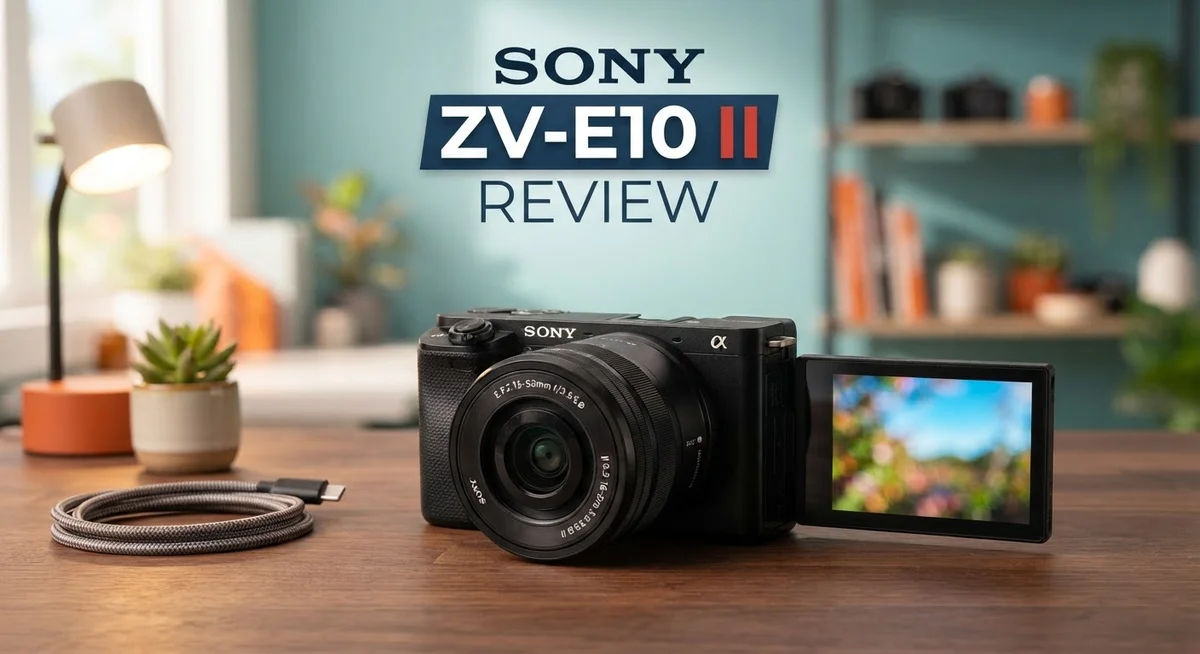
This camera targets vloggers who want more control. You get a flip-out vari-angle touchscreen with a rotating UI. That means easy framing for selfies and interviews alike.
The 10-bit high-speed recording stands out too. It captures smooth footage in good light. Headphone and mic sockets let you monitor audio like a pro.
But does it solve every vlogging challenge? Not quite. The lack of in-body stabilization raises questions for handheld shooters.
This review breaks down every feature. We check the pros, the cons, and how the ZV-E10 II stacks up against rivals like the Canon EOS R50 and Fuji X-M5. Let’s find out if it deserves a spot in your camera bag.
In a Nutshell
The Sony ZV-E10 II packs strong features into a small body. Here is what stands out most for creators.
-
Sensor performance shines. The 26MP APS-C sensor delivers impressive dynamic range. It handles high ISO situations with ease.
-
Video quality holds up well. 4K recording looks sharp in controlled environments. Lighting still matters a lot here.
-
Lens flexibility adds value. You can swap lenses based on your shooting needs. This gives more creative freedom than fixed lens cameras.
-
Connectivity options are solid. Headphone and mic sockets support proper audio monitoring. USB-C streaming works smoothly for live content.
-
Stabilization remains a concern. No IBIS means handheld footage can look shaky. You will need a gimbal or steady hands for smooth shots.
-
Competition is fierce in this category. The Canon EOS R50 and Fuji X-M5 offer similar appeal. Nikon Z50 also competes for the same creator audience.
Sony built this camera for vloggers who want more control. It rewards careful setup but expects some compromises too.
Sensor and Image Quality
The 26MP APS-C sensor sits at the heart of what makes this camera tick for content creators. You get excellent color accuracy and impressive dynamic range that handles both bright skies and dark shadows without losing detail. This means your footage stays usable even when lighting conditions shift unexpectedly during a shoot.
High ISO performance deserves special attention here. The sensor handles sensitivity levels up to 32000 cleanly, so you can shoot indoors or at night without introducing excessive noise. For vloggers filming in coffee shops or dimly lit studios, this flexibility proves invaluable.
The 10-bit color depth during 4K recording sets this camera apart from many competitors in this category. You capture more color information, which gives you greater freedom during editing. Shadows and highlights retain more detail, making color grading smoother and more forgiving.
One thing to note: image quality in 4K looks sharp and detailed when lighting conditions cooperate. The sensor resolves fine details well, and colors appear natural straight out of the camera. However, you’ll see the most impressive results in controlled studio environments rather than bright outdoor settings where the lack of in-body stabilization becomes more noticeable.
The interchangeable lens system means you’re not locked into one focal length or aperture. Pairing the sensor with quality lenses amplifies its strengths. A fast 35mm prime, for example, lets you maximize that high ISO capability in low light situations.
Raw file support opens creative possibilities too. You can shoot in S-Log2 for maximum flexibility during color correction, though this requires more work in post-production. For creators who prefer working with JPEGs straight out of the camera, the default color profiles deliver satisfying results.
The real strength here lies in consistency. This sensor produces reliable, predictable results across various shooting scenarios. Whether you’re capturing talking head footage or B-roll, the image quality remains steady. That reliability matters when you’re publishing content regularly and need to maintain visual consistency across your uploads.

- Sony USA Authorized. Sony Alpha ZV-E10 II Mirrorless Camera with 16–50mm Lens (Black), 64GB card...
- All-in-One Vlogging Kit – The Sony ZV-E10 II comes bundled with the 16–50 mm OSS power zoom...
- High-Resolution Sensor for Pro Content – Featuring a 26 MP APS-C Exmor R CMOS sensor and next-gen...
Last update on 2026-11-06 / Affiliate links / Images from Amazon Product Advertising API
Video Performance and Recording Capabilities
The Sony ZV-E10 II delivers solid 4K video performance when conditions favor your shot. The camera handles frame rates up to 120fps in 1080p, giving you smooth slow motion options for dynamic content. You get 10-bit color depth during 4K recording, which means richer color gradations and more flexibility during post-production editing.
Recording stability presents a real challenge here. Without in-body image stabilization, your handheld footage relies entirely on lens stabilization or external tools. This matters most if you shoot vlogs while walking or moving around. Tripod work eliminates this concern, but mobile creators should factor this limitation into their decision.
The camera excels at capturing fine detail in well-lit environments. Your 4K clips show sharp edges, smooth gradients, and clean transitions between light and shadow. Low light performance drops noticeably, as expected from an APS-C sensor without IBIS. You’ll need either faster lenses or additional lighting to maintain quality in dim spaces.
Audio recording capabilities stand out for creators. The dedicated mic socket lets you connect external microphones, while the headphone jack enables real-time monitoring. This setup prevents surprise audio problems during filming, a common frustration with entry-level cameras.
USB-C connectivity opens streaming possibilities. You can stream 4K video at 30fps directly to platforms, useful for live sessions or remote work. The 5Gbps transfer speed keeps data flowing smoothly without bottlenecks.
The flip-out touchscreen rotates and tilts, making it simple to frame shots from unusual angles. This vlogging-specific feature works well for selfie shots or creative compositions. The rotating UI adapts to your screen position automatically.
Heat management deserves mention. Extended 4K recording sessions generate warmth, and the camera will throttle performance if temperatures climb too high. This rarely affects short clips but impacts longer documentary-style shoots.
Overall, video performance hits the mark for content creators who prioritize image quality and audio control over handheld convenience. You’ll get professional-looking results with proper planning and technique.
Design and Vlogging Features
The Sony ZV-E10 II puts design choices front and center for vlogging work. The flip-out vari-angle touchscreen rotates smoothly, letting you frame shots from awkward positions without contorting your body. This screen matters more than you might think when you’re recording yourself talking to the camera.
The rotating UI adapts to portrait and landscape modes automatically. You see your settings clearly no matter how you hold the camera. The touchscreen itself feels responsive and makes menu navigation quick.
Build quality feels solid without being heavy. The camera sits comfortably in your hands during extended shooting sessions. Buttons and dials respond with satisfying clicks. The grip provides enough purchase that you won’t worry about dropping it mid-recording.
Audio connectivity stands out for creators. Both headphone and microphone sockets live on the camera body. You can monitor sound in real time and connect external mics for cleaner dialogue capture. This setup beats relying on built-in audio alone.
USB-C connectivity opens streaming doors. The 5Gbps transfer speed supports 4K/30 streaming directly to platforms. You won’t need complex workarounds to go live. This feature matters if streaming is part of your content strategy.
One design limitation hits hard: no in-body stabilization. Handheld footage shows movement that smoother cameras hide. Walking while recording reveals this weakness immediately. You’ll want a tripod or gimbal for polished results. This absence pushes your shooting style toward static setups or gimbal-assisted movement.
The camera lacks weather sealing too. Rain or splashing water demands careful handling. Outdoor vlogging in uncertain weather requires protective gear or caution.
The interchangeable lens system adds flexibility that fixed-lens cameras cannot match. You swap lenses between shoots to match your content needs. Wide angles work for vlogs. Longer focal lengths suit B-roll capture. This versatility justifies carrying extra glass.
The overall design philosophy prioritizes content creation over specifications. Every feature connects to vlogging workflows. The designers understood what creators actually need when filming themselves or their surroundings. That focus shows in the details.
Top 3 Alternatives
Canon EOS M50 Mark II

- 24.1 megapixel (aps-c) cmos sensor with iso 100-25600 (h: 51200).
- digic 8 image processor with auto lighting optimizer.
- improved dual pixel cmos af and eye detection af (still/movie servo af support).
Last update on 2026-11-06 / Affiliate links / Images from Amazon Product Advertising API
The Canon EOS M50 Mark II works well for content creators who want simple controls and fast autofocus. This camera has a flip screen that points toward you, making selfies and vlogging easy. The autofocus system tracks faces and eyes quickly, which helps when you move around while filming.
You get 4K video at 24fps, which is good for YouTube and social media. The camera feels light in your hands, so carrying it around stays comfortable. Battery life is decent, but you may need a spare battery for long shooting days.
Fujifilm X-S10

- It’s All About How It Feels: X-S10 has been designed to provide on-the-go photographers with...
- Making State-of-the-Art Simple: Designed to be simple and minimalist on the outside, X-S10 still...
- Putting Stability in Your Hands: To document the most amazing moments, you need to be in the right...
Last update on 2026-11-06 / Affiliate links / Images from Amazon Product Advertising API
The Fujifilm X-S10 offers film simulations that add color and mood to your videos without extra editing work. This camera has a retro design that looks nice on camera. The autofocus performs well in low light, which helps when you film indoors or at night.
4K video quality is sharp and detailed. The camera body is compact, making it perfect for travel vlogging. You’ll appreciate the in-body stabilization, which keeps footage smooth when you walk or move.
Nikon Z30

- Designed for creators, vloggers and streamers: Nikon's easy to use Z 30 mirrorless 4K camera with a...
- Pro-grade video quality: Crisp 4K resolution, autofocus with eye tracking for people and pets...
- Vlogger essentials: Flip out touchscreen selfie monitor, built-in stereo microphone with adjustable...

Last update on 2026-11-06 / Affiliate links / Images from Amazon Product Advertising API
The Nikon Z30 is a compact camera built for vlogging and content creation. It has a flip screen and excellent autofocus that keeps your face sharp while you talk on camera. The 4K video looks clean and professional.
This camera weighs very little, so it fits easily in a backpack. The battery lasts longer than many competitors, which means fewer charging breaks during shoots. The interface is intuitive, so you spend less time learning buttons and more time creating content.
Autofocus and Tracking Performance
The Sony ZV-E10 II uses a fast hybrid autofocus system that combines phase detection and contrast detection. This dual approach helps the camera lock onto subjects quickly in most shooting situations. The system tracks moving subjects with reasonable accuracy, making it suitable for vlogging and content creation work.
Real world performance shows solid results when you’re filming yourself or tracking moderate movement. The camera maintains focus during talking head videos without hunting or hunting back and forth. Face detection works reliably when your face fills a reasonable portion of the frame. The autofocus responds well to sudden movements, though it’s not lightning fast compared to some flagship models.
Eye autofocus performs decently for stationary subjects. When you’re positioned directly in front of the camera, the system recognizes your eye and keeps it sharp. Performance drops noticeably when you move sideways or turn your head at sharp angles. The feature works best in controlled vlogging setups rather than dynamic action scenarios.
Tracking performance has clear strengths and weaknesses. The camera excels at following subjects that move predictably across the frame. Erratic or fast movements sometimes cause the focus to lag slightly. In bright daylight, tracking stays consistent. Low light situations introduce occasional focus hunting, which matters for evening content creators.
One limitation stands out: the autofocus system can struggle with fast moving subjects or complex backgrounds. If you’re filming sports or wildlife, expect occasional focus misses. The camera performs better with simpler scenes and controlled environments.
The touchscreen autofocus point selection adds convenience. You can tap anywhere on the screen to shift focus, which speeds up repositioning during filming. This feature feels natural for creators who already use smartphones.
Overall, autofocus and tracking work well for the camera’s intended purpose. The system handles vlogging scenarios smoothly and keeps up with typical content creation demands. It won’t match specialized video cameras or higher end models, but it delivers reliable performance for its category. The autofocus experience feels responsive enough that most creators won’t feel limited by it.
Connectivity and Streaming
The Sony ZV-E10 II connects to your streaming setup through USB-C at 5Gbps speeds. This allows you to stream 4K video at 30fps directly to platforms like YouTube and Twitch. The connection handles data transfer smoothly for most creators working in controlled environments.
The camera features both headphone and microphone sockets on the body. You can monitor audio in real time with headphones while recording. External microphones connect easily, giving you full control over sound quality during streams. This dual audio setup separates the ZV-E10 II from many competitors in its class.
Wireless connectivity options remain limited. The camera lacks built in WiFi or Bluetooth for remote control or file transfer. You’ll need to rely on USB-C for all data movement and streaming tasks. This simplifies the design but removes flexibility for some workflows.
The rotating touchscreen adapts to portrait and landscape modes automatically. When you flip the screen, the UI rotates with it. This matters because streaming often requires portrait orientation for mobile platforms. The touch interface lets you tap to set autofocus points while recording, keeping your hands free for framing.
Heat management becomes important during extended streaming sessions. The camera handles sustained 4K recording better than expected, though airflow around the body helps during long broadcasts. Monitoring temperature ensures your stream stays stable without unexpected shutdowns.
One key limitation affects handheld streaming work. The lack of in body stabilization means footage shows noticeable movement. You’ll want a tripod or gimbal for professional looking streams. This pushes creators toward using external stabilization tools rather than relying on the camera alone.
The USB-C port doubles as your power input during streaming. You can keep the battery charged while broadcasting, eliminating downtime between sessions. This practical feature supports longer streaming events without battery swaps.
Overall, the ZV-E10 II handles streaming and connectivity well for creators who work from fixed positions. The audio sockets and USB-C streaming make it capable for content creation. Plan for external stabilization if you need smooth handheld footage during your broadcasts.
Pros and Cons
Pros
- 26MP APS-C sensor delivers impressive dynamic range and strong high ISO performance
- Flip-out vari-angle touchscreen rotates to portrait mode automatically for vlogging
- 10-bit high-speed recording and USB-C streaming at 5Gbps keep your content looking professional
- Headphone and microphone sockets built into the body eliminate adapter clutter
- Interchangeable lens system lets you swap glass for different creative shots
Cons
- No in-body stabilization means handheld footage shows noticeable movement and shake
- Autofocus struggles with fast moving subjects or complex backgrounds during tracking
- Camera lacks weather sealing and built-in WiFi or Bluetooth connectivity
- Heat management becomes an issue during extended streaming sessions
Who Should Buy It
The Sony ZV-E10 II works best for content creators who film themselves or record stationary subjects. If you make vlogs, tutorials, or sit-down videos, this camera delivers the performance you need.
Vloggers will appreciate the flip-out touchscreen that rotates to portrait mode automatically. You can frame yourself easily and tap to focus while recording. The rotating UI adapts to your shooting angle, so switching between landscape and portrait feels natural.
The camera suits creators who want an interchangeable lens system. You can swap lenses to get wide shots, tight close-ups, or creative perspectives. This flexibility helps you tell better stories without being locked into one lens.
Streamers benefit from the USB-C connection at 5Gbps speeds. You can stream 4K content to your audience with solid quality. The headphone and microphone sockets let you monitor audio and connect external mics without adapters. Heat management works reasonably well during extended sessions, though you’ll want to monitor temperature during long streams.
Video enthusiasts who film in controlled environments will see strong results. The 26MP APS-C sensor captures impressive detail and handles high ISO situations well. 10-bit high-speed recording gives you professional-grade footage that holds up in post-production.
However, skip this camera if you need in-body stabilization for handheld work. The lack of IBIS means handheld footage shows noticeable movement and shake. If you film fast-moving subjects or work in complex backgrounds, autofocus can struggle with tracking.
This camera is not ideal for photographers who need weather sealing or extensive connectivity. It lacks WiFi and Bluetooth for remote control. You won’t find weather resistance for outdoor shooting in harsh conditions.
The ZV-E10 II fits creators who value a focused feature set over a universal toolbox. You get vlogging tools, solid video performance, and lens flexibility in one package. If your content matches this camera’s strengths, it delivers results that justify your investment in the system.
Final Verdict
The Sony ZV-E10 II earns its spot as a strong APS-C creator camera. DPReview scores it 85%, reflecting solid overall performance. That rating puts it ahead of many rivals in its class.
This camera shines when you compare its sensor quality against competitors like the Canon EOS R50 and Fuji X-M5. Sony’s color science and dynamic range often give it an edge in real world testing.
The Nikon Z50 and Panasonic G95 offer similar interchangeable lens flexibility. Yet the ZV-E10 II pulls ahead with its vlogging focused design and touchscreen interface.
Think of this camera as a tool built for growth. You start with the kit lens, then expand your collection as your skills improve. That flexibility sets it apart from fixed lens alternatives.
Content creators who prioritize image quality over stabilization will find this camera rewarding. The sensor performance justifies choosing this model for many creators.
However, this camera asks you to accept certain tradeoffs. You gain excellent image quality but lose some convenience features found in competing models.
Your shooting style determines whether this tradeoff makes sense. Stationary vloggers and studio creators benefit most from what Sony offers here.
Think about your typical shooting environment before deciding. Controlled settings with good lighting let this camera perform at its best.
Compare this model against your current gear honestly. If you already own Sony lenses, switching systems adds unnecessary complications.
The ZV-E10 II represents a thoughtful update to Sony’s creator lineup. It refines the formula rather than reinventing it completely.
Choose this camera if you value sensor performance and creative flexibility. Skip it if stabilization and connectivity matter more for your workflow.
Overall, this camera earns a recommended rating for the right creator. It delivers where it counts most while asking reasonable compromises elsewhere.
Your final decision should match your specific creative needs and shooting habits.
Frequently Asked Questions
Does the Sony ZV-E10 II have image stabilization?
No, it doesn’t have in-body stabilization. This is a significant limitation if you shoot handheld footage frequently. You’ll notice camera shake in your videos, especially when walking or moving around. To combat this, you can use a tripod, gimbal, or invest in stabilized lenses with optical image stabilization.
Can you stream live with this camera?
Yes, absolutely. The USB-C connection supports 5Gbps data transfer, which lets you stream 4K content directly to platforms like YouTube or Twitch. You won’t need external capture devices for most streaming needs. This feature makes the ZV-E10 II practical for content creators who broadcast regularly.
Is the flip-out screen good for vlogging?
The vari-angle touchscreen rotates and flips out, which is helpful for framing yourself during recordings. The rotating UI adapts to portrait and landscape modes automatically. However, the lack of stabilization still makes handheld vlogging challenging. The screen itself is responsive and easy to use while recording.
How does autofocus perform during video?
Autofocus works well for stationary subjects and controlled environments. It struggles when you track fast-moving objects or film in complex backgrounds with lots of detail. For studio setups or self-recorded content, autofocus is reliable. For dynamic action or unpredictable movement, you may experience focus hunting or missed subjects.
What lenses work with this camera?
The ZV-E10 II uses Sony’s E-mount system. You can choose from Sony’s native E-mount lenses or adapt third-party options. The interchangeable lens system gives you creative flexibility for different shooting styles. Popular choices include wide-angle lenses for vlogging and telephoto lenses for detail shots.

DK is a tech enthusiast and product reviewer dedicated to helping readers explore the ever-evolving world of technology. With a passion for testing gadgets, apps, and appliances, DK delivers honest, in-depth reviews and practical buying guides to make your tech decisions easier.