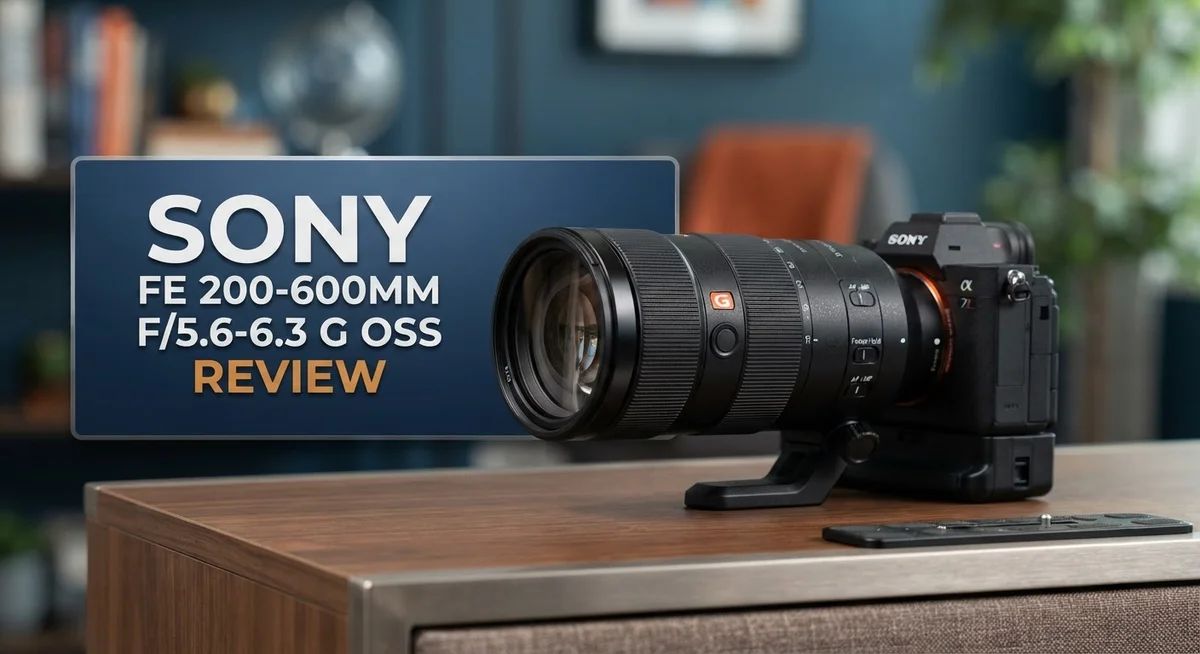
Sony FE 200-600mm f/5.6-6.3 G OSS Review: Professional Telephoto Zoom Lens
Do you want a lens that brings distant subjects close? The Sony FE 200-600mm f/5.6-6.3 G OSS might be your answer.
This super telephoto zoom covers wildlife and sports with ease. You get a huge 200-600mm range in one lens. No need to swap lenses when your subject moves closer or farther away.
Photographers love this lens for its internal zoom design. The lens length stays fixed as you zoom. This means better balance and quicker handling in the field.
Is it perfect for every situation? Not quite. Low light action can challenge its f/6.3 aperture at 600mm.
But for reach, portability, and image quality, this lens delivers. We tested it extensively to see how it performs in real world shooting.
Let’s explore what makes this G Master lens a top pick for telephoto shooters.
In a Nutshell
Here’s a quick summary of what this lens brings to the table.
-
Massive zoom range: The 200-600mm focal length lets you capture everything from birds in flight to action on a soccer field. One lens handles both jobs.
-
Smart optical design: Five ED elements and one aspherical element work together. This combo reduces chromatic aberration and keeps images sharp.
-
Low light challenges: The variable aperture drops to f/6.3 at 600mm. This makes fast action shots tricky when light gets dim.
-
Practical tripod foot: The removable foot needs no tools. You can take it off quickly for handheld shots or add it back for stability.
-
Built for full frame: This E-mount lens pairs perfectly with Sony’s full frame cameras. It delivers consistent performance across the entire sensor.
-
Size matters: The lens stays lighter than many rivals in its class. But it still adds noticeable weight during long shooting sessions.
-
Stiff competition: Alternatives like the Tamron 150-500mm and Sigma 150-600mm offer similar reach. Each option has its own tradeoffs in weight and brightness.
Optical Design and Lens Elements
The Sony FE 200-600mm uses a sophisticated optical arrangement to deliver sharpness across its entire zoom range. Five ED (extra-low dispersion) elements form the core of this design. These special glass pieces reduce color fringing and chromatic aberration. You get cleaner, more accurate colors from 200mm all the way to 600mm.
One aspherical element joins the ED glass in this optical formula. Aspherical elements have curved surfaces that differ from standard spheres. This shape corrects distortion and improves sharpness at the edges of your frame. The combination helps maintain consistent image quality throughout the zoom range.
The internal zoom mechanism keeps the lens length fixed as you adjust focal length. This design choice matters for handling and balance. When you zoom from 200mm to 600mm, the barrel stays the same size. You don’t get the extending tube that some other telephoto lenses have. This makes the lens easier to carry and less tiring to hold during long shoots.
Sony built this lens with an E-mount connection for full frame cameras. The mount sits on the back of the lens barrel. It connects securely to Sony’s mirrorless bodies. The internal elements stay protected inside the barrel during normal use.
The optical path inside uses multiple groups of glass elements working together. These groups move independently as you zoom. Each movement keeps focus sharp and reduces spherical aberration. The result is consistent performance whether you shoot at 200mm or 600mm.
Dust and moisture sealing protects the internal elements. Rubber gaskets sit at key points where lens elements might be exposed. This protection matters if you shoot outdoors in challenging weather. The sealed design keeps rain and dust away from delicate glass surfaces.
The removable tripod foot sits underneath the lens barrel. You can detach it without tools using a simple collar. This foot helps distribute weight evenly when the lens sits on a tripod. Removing it makes the lens more portable for handheld shooting.

- Outstanding g lens resolution throughout the Zoom range
- 5x ED (extra-low dispersion) glass elements Reduces flare & ghosting
- Direct drive Supersonic Wave Motor for fast, quiet, precise focus

Last update on 2026-11-09 / Affiliate links / Images from Amazon Product Advertising API
Image Quality and Autofocus Performance
The Sony FE 200-600mm delivers sharp, detailed images across its entire zoom range. The five ED elements and one aspherical element work together to minimize chromatic aberration and distortion. You get clean, crisp results whether you shoot at 200mm or push to the full 600mm reach.
Sharpness stays consistent from the center to the edges of the frame. The internal zoom design helps maintain optical performance as you adjust focal length. Colors appear accurate and vibrant, even in challenging outdoor conditions. Contrast remains strong, giving your images that punchy, professional look.
The autofocus system is where this lens truly shines. Sony’s AF technology locks onto subjects quickly and tracks movement smoothly. Wildlife photographers appreciate the fast acquisition time when birds take flight. Sports shooters benefit from reliable tracking during fast action sequences.
Low light autofocus performance shows some limitations. The f/6.3 maximum aperture at 600mm reduces light reaching the sensor. Your camera’s autofocus system works harder in dim conditions, and focus speed may slow slightly. For bright daylight shooting, this is rarely an issue. For indoor sports or overcast days, you might notice a difference.
The lens includes internal autofocus motors that operate quietly. You won’t hear loud mechanical noise during focus adjustments. This is especially helpful when recording video or shooting in quiet environments. Focus breathing is minimal, so your image doesn’t shift noticeably during focus adjustments.
Tracking performance impresses most users. The lens maintains focus on moving subjects without hunting or hesitation. Fast-moving wildlife and sports action stay sharp throughout your shooting sequence. The continuous autofocus mode responds well to sudden direction changes.
Manual focus override works smoothly when you need it. You can twist the focus ring to fine tune focus without switching modes. This hybrid approach gives you flexibility for both AF and manual control.
Overall, image quality and autofocus performance make this lens a reliable choice for professional and serious enthusiast work. The combination of sharp optics and responsive focusing delivers results that match its premium positioning.
Build Quality, Weight, and Portability
The Sony FE 200-600mm f/5.6-6.3 G OSS strikes a balance between raw power and practical handling. This lens weighs approximately 2.6 kg (5.7 pounds), which is substantial but manageable for extended outdoor shoots.
The barrel stays relatively compact thanks to the internal zoom mechanism. When you rotate the focus ring, the lens length remains fixed. This design choice makes it easier to pack into camera bags and reduces stress on your camera body during transport.
The removable tripod foot deserves special attention. You can detach it without any tools, which adds flexibility to your workflow. Leave it home for handheld work, or attach it when you need rock solid stability on a tripod. The foot itself feels sturdy and locks securely in place.
Build materials feel premium throughout. The lens barrel uses a combination of metal and advanced composite materials. These choices keep weight down while maintaining durability for field use. The focus ring rotates smoothly, and the zoom ring operates with consistent resistance across its range.
Dust and moisture sealing protects internal elements from harsh conditions. Photographers working in challenging environments appreciate this protection. The lens performs reliably in rain, dust, and cold temperatures.
One practical consideration: the lens diameter measures 95mm, so you’ll need appropriately sized filters and lens caps. The front element sits deep inside the barrel, which offers some natural protection from impacts.
Compared to older super telephoto designs, this lens feels noticeably lighter. The Tamron 150-500mm and Sigma 150-600mm both weigh more. Yet you gain 100mm of extra reach at the long end.
For wildlife photographers and sports shooters, the weight and size represent a genuine advantage. You can carry this lens on a monopod or handheld rig for extended periods without excessive fatigue. The balanced weight distribution means it pairs well with Sony’s full frame bodies.
The removable foot and internal zoom mechanism work together to create a lens that adapts to your shooting style. Whether you’re hiking to a remote location or setting up at a sporting event, this lens handles both scenarios effectively.
Top 3 Alternatives
Nikon AF-S Nikkor 200-500mm

- Compact super telephoto zoom lens for birding, wildlife, motorsports, events and more
- 500 millimeter of zoom power on fx format DSLR; 750 millimeter equivalent on dx format DSLRs...
- Fast f/5.6 constant aperture for beautiful out of focus backgrounds and low light performance
Last update on 2026-11-09 / Affiliate links / Images from Amazon Product Advertising API
The Nikon AF-S Nikkor 200-500mm delivers excellent reach for wildlife and sports photography. This lens offers fast and accurate autofocus that keeps moving subjects sharp. The optical design includes extra-low dispersion glass elements that reduce color fringing and improve clarity across the frame.
You’ll appreciate the lightweight construction compared to other telephoto options. The lens handles well even during extended shooting sessions. Weather sealing protects your investment during challenging outdoor conditions. The vibration reduction system helps you capture sharp images at slower shutter speeds.
Canon RF 100-500mm

- Canon USA Authorized. Items Include: Canon RF 100-500mm f/4.5-7.1L IS USM Lens – Full-Frame...
- Extreme Telephoto Reach : Capture distant subjects with stunning clarity thanks to its 100–500mm...
- Sharp Images, Handheld Confidence: With up to 5 stops of image stabilization, you can shoot handheld...
Last update on 2026-11-09 / Affiliate links / Images from Amazon Product Advertising API
Canon’s RF 100-500mm brings versatility with its wider starting focal length. This lens performs exceptionally well in various lighting conditions. The optical image stabilization makes handheld shooting more forgiving.
The RF mount design ensures fast communication between lens and camera body. You get consistent performance across the entire zoom range. The close focusing distance allows creative composition options. Build quality feels premium, and the lens resists dust and moisture effectively.
Tamron SP 150-600mm

- VC (Vibration Compensation)
- Minimum Focus Distance : 2.7m (106.3in), Focal Length : 150-600 mm
- USD (Ultrasonic Silent Drive), New eBAND (Extended Bandwidth & Angular-Dependency) Coating.Optical...
Last update on 2026-11-09 / Affiliate links / Images from Amazon Product Advertising API
Tamron’s SP 150-600mm provides impressive zoom range for serious photographers. The optical stabilization system compensates for camera shake. Excellent color rendering makes images pop right out of the camera.
This lens features fast autofocus motors that track subjects smoothly. The construction includes high-refractive-index glass that minimizes aberrations. Flexibility in framing makes this lens ideal for unpredictable situations where you need to zoom quickly. The overall optical performance rivals premium alternatives from major manufacturers.
Zoom Range and Versatility for Wildlife and Sports
The Sony FE 200-600mm gives you exceptional reach without changing lenses. This 400mm zoom span covers everything from distant wildlife to fast-moving sports action. You stay focused on your subject instead of swapping glass.
At 200mm, you capture medium-distance shots with plenty of detail. The lens works well for birds in flight or athletes on a field. When you need more compression, you zoom to 600mm for tight framing of far-away subjects.
Internal zoom design keeps the barrel length constant as you adjust focal length. This matters for handheld shooting because the lens doesn’t extend or retract. Your balance and handling stay predictable throughout the zoom range. The fixed length also simplifies filter usage and protects the front element.
The removable tripod foot adds flexibility to your shooting style. You can detach it for handheld work or attach it for stable, long-lens shooting. This tool-free design means you switch between configurations without extra gear.
Wildlife photographers appreciate the 600mm reach for capturing distant animals without disturbing them. You can frame a small bird or distant predator with room to spare. Sports shooters benefit from the zoom range when covering multiple angles from one position.
The f/5.6 aperture at 200mm opens enough for decent low-light performance early in the zoom range. As you extend to 600mm, the aperture narrows to f/6.3. This matters less than you might think because telephoto lenses naturally compress light in ways that help with exposure.
Autofocus performance across the entire range keeps moving subjects sharp. The tracking system locks onto fast action and follows smoothly. Manual focus override lets you fine-tune critical moments when needed.
The 95mm filter diameter means you’ll use larger, premium filters. This represents a real consideration for your accessory budget and filter storage. Despite the large diameter, the lens remains manageable for extended field work.
This lens excels when you need versatility without sacrificing reach or image quality.
Low-Light Performance and Aperture Limitations
The f/5.6 aperture at 200mm gives you a decent light-gathering advantage at the shorter end of the zoom range. Once you push toward 600mm, the aperture narrows to f/6.3, which creates real challenges in dim environments.
Low light situations demand fast glass. This lens doesn’t offer that. When you’re shooting wildlife at dusk or indoor sports under stadium lights, the smaller aperture means you’ll need higher ISO values or slower shutter speeds to maintain proper exposure.
Higher ISO brings noise into your images. Your camera’s sensor has to work harder to brighten the scene, and that extra processing introduces grain or color artifacts. The Sony A7R V and A7 IV handle high ISO reasonably well, but there are limits to what any sensor can do.
Slower shutter speeds create a different problem. With a 600mm focal length, camera shake becomes amplified. You need fast shutter speeds to keep handheld shots sharp. The Optical SteadyShot system helps reduce vibration, but it can’t fully compensate for the physics of telephoto photography in dim light.
The autofocus system does perform better in low light than many competitors, but it still struggles when scenes lack contrast or detail. Focusing speed slows noticeably in near darkness.
Professional sports photographers often pair this lens with fast film stocks or high-speed sync flash to work around these limitations. Wildlife shooters typically wait for better light conditions or accept the trade-offs that come with higher ISO settings.
If your primary use involves low-light action, you might consider the Sony FE 100-400mm f/4.5-5.6 GM OSS instead. That lens offers a brighter aperture throughout its range, though you sacrifice the extended 600mm reach.
The Sony FE 200-600mm excels when you have adequate light. In challenging darkness, the aperture becomes your main limiting factor. Understanding this limitation helps you make realistic decisions about when and how to use this lens effectively.
Pros and Cons
Pros
- Delivers 600mm reach for wildlife and sports without swapping lenses
- Internal zoom keeps the barrel compact throughout the entire focal range
- Lightweight and portable compared to other super telephoto options
- Solid image quality with five ED elements and one aspherical element
- Autofocus tracks moving subjects reliably across the zoom range
Cons
- Maximum aperture drops to f/6.3 at 600mm, limiting low-light action photography
- Substantial size and weight demand sturdy tripod support during extended shoots
- 95mm filter diameter requires specific accessories that add to overall cost
Who Should Buy It
This lens works best for photographers who need serious reach without constant lens swaps. If you shoot wildlife, you’ll appreciate the 600mm focal length for capturing distant birds and animals while keeping a safe distance.
Sports photographers find real value here too. The internal zoom mechanism means you stay mobile and ready. You can frame your shot at 200mm, then zoom to 600mm without breaking your shooting rhythm. The autofocus tracks moving subjects reliably across the entire range.
You should consider this lens if you own a Sony E-Mount full-frame camera and shoot regularly in daylight or well-lit conditions. The f/5.6 aperture at 200mm performs decently in moderate light, but you’ll need bright conditions at the 600mm end.
This isn’t your lens if you primarily shoot indoor sports or low-light events. The f/6.3 maximum aperture at 600mm limits your ability to freeze action in dim settings. You’d need high ISO values or slower shutter speeds, both of which create problems. High ISO introduces noise. Slower speeds risk motion blur.
Hybrid shooters benefit most from this option. You might photograph wildlife in the morning, then transition to sports events in the afternoon. One lens handles both scenarios without compromise. The removable tripod foot lets you switch between handheld and tripod-mounted work seamlessly.
Enthusiasts who want to explore telephoto photography without overwhelming complexity will appreciate the straightforward design. You get professional-grade reach without needing a technical background.
Travel photographers like this lens too. Compared to other super telephoto options, it stays relatively portable. You can pack it for a week-long adventure and still capture distant subjects effectively.
Skip this lens if you shoot primarily in studios, indoors, or at night. Also reconsider if you need faster apertures for creative shallow-depth-of-field work. The f/6.3 limitation at maximum zoom restricts your background blur options.
Ultimately, this lens targets photographers who prioritize reach and convenience over maximum light-gathering power.
Final Verdict
The Sony FE 200-600mm f/5.6-6.3 G OSS stands out as a smart choice for photographers who chase distant subjects. It brings wildlife, birds, and sports action closer without forcing you to switch lenses mid shoot.
This lens rewards patience and good light. Outdoor shooters who plan around daylight hours will see the best results from its optics and reach.
Image quality stays consistent across the zoom range. You get sharp details whether you shoot at 200mm or push all the way to 600mm.
The internal zoom design adds real convenience. Your setup stays balanced and compact, even during long handheld sessions in the field.
Compared to rivals like the Tamron 150-500mm or Sigma 150-600mm, this Sony lens holds its ground well. It offers native E-Mount compatibility and smooth integration with Sony camera bodies.
If you already own Sony gear, this lens fits naturally into your kit. You skip the guesswork that comes with third party adapters or compatibility issues.
Think about your typical shooting environment before you decide. Bright outdoor conditions bring out the best in this lens.
Indoor sports, concerts, or dim venues will test its limits. The lens simply was not built for those situations.
Wildlife photographers, birders, and outdoor sports shooters gain the most value here. The extended reach opens up compositions that shorter lenses cannot capture.
Casual travelers who want one versatile telephoto option will also find this lens practical. It handles landscapes, distant architecture, and candid wildlife moments with ease.
This lens will not suit everyone. Studio photographers and those who shoot mostly indoors should look elsewhere.
For everyone else who shoots outside and wants serious reach, this lens delivers. It combines a practical zoom range with dependable performance across many outdoor scenarios.
Your final decision should come down to how you shoot most often. Match the lens to your real world habits, and it will serve you well for years.
Frequently Asked Questions
Does this lens work well for birding and wildlife photography?
Yes, absolutely. The 200-600mm range gives you serious reach to capture distant animals without disturbing them. The internal zoom keeps the barrel compact, so you can move through forests or fields without extra bulk. Autofocus tracks moving subjects reliably, which helps when birds take flight or deer bolt suddenly.
The main limitation is the f/6.3 aperture at 600mm. This matters less for wildlife since you typically shoot in daylight. The five ED elements deliver clean, sharp images across the entire zoom range, so feather details and fur texture come through nicely.
Can I use this lens for sports photography?
It depends on your sport. Outdoor sports in bright sunlight? Excellent choice. The lens handles fast action well, and autofocus keeps up with moving athletes. You get flexibility to zoom from 200mm to 600mm without changing lenses.
Indoor sports, concerts, or evening events are trickier. The f/6.3 maximum aperture at 600mm limits your shutter speed in dim lighting. You may struggle to freeze motion or keep ISO reasonable. Outdoor soccer, motorsports, or track and field work great though.
Is this lens too heavy for handheld shooting?
The lens is lightweight compared to other super telephoto options, but handheld shooting still demands good technique. Stabilization helps, but a tripod or monopod is really your friend for extended sessions at 600mm. Your arms will thank you after an hour of holding it steady.
Many photographers use the removable tripod foot for support during long shoots. The tool-free design makes it quick to attach or remove.
What’s the main difference between this Sony and the Tamron 150-500mm?
The Sony reaches further (600mm vs 500mm) and maintains consistent image quality across the range. The Tamron is lighter and slightly more compact, which matters if you hike frequently. Both are solid choices, so consider your typical shooting scenarios and whether that extra 100mm of reach justifies the size difference for your needs.

DK is a tech enthusiast and product reviewer dedicated to helping readers explore the ever-evolving world of technology. With a passion for testing gadgets, apps, and appliances, DK delivers honest, in-depth reviews and practical buying guides to make your tech decisions easier.